




Chinese carmakers are stepping up their challenge to Tesla in the global race to dominate autonomous mobility, with the latest advances unveiled at the Beijing Auto Show signalling a decisive shift toward large-scale robotaxi deployment.
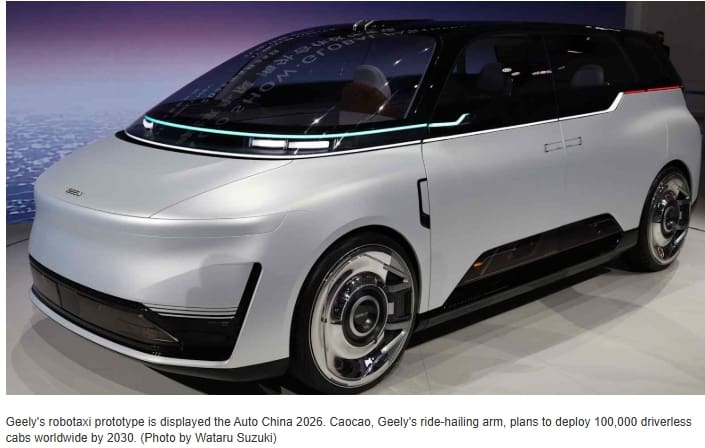
At the heart of this push is a growing confidence among Chinese manufacturers that the era of fully autonomous ride-hailing services is no longer theoretical but fast approaching commercial reality. Companies including BYD, XPeng, and Baidu used the Beijing showcase to highlight next-generation self-driving systems, purpose-built robotaxi vehicles, and ambitious rollout timelines.
Unlike previous years, where concept vehicles dominated headlines, this year’s exhibition focused on real-world applications. Demonstrations featured urban navigation systems capable of handling dense traffic, complex intersections, and unpredictable pedestrian movement—long considered key barriers to autonomy. Several companies also revealed integrated fleet management platforms designed to support large networks of driverless taxis operating in major cities.
Baidu, already a frontrunner through its Apollo Go service, announced plans to expand its robotaxi operations to additional Chinese cities, building on pilot programmes that have logged millions of kilometres. Meanwhile, XPeng showcased upgraded driver-assistance systems edging closer to full autonomy, with executives indicating that commercial robotaxi services could follow within a few years.
The scale and speed of development reflect a broader national strategy. China has made autonomous driving a priority sector, with regulatory support, dedicated testing zones, and significant investment accelerating innovation. In cities such as Beijing, Shanghai and Shenzhen, local governments have granted permits for driverless testing and limited commercial operations, giving domestic firms a crucial advantage in real-world data collection.
This environment contrasts with the more cautious regulatory landscape facing Tesla and other Western competitors. While Tesla continues to refine its Full Self-Driving (FSD) technology, it has yet to launch a fully autonomous robotaxi service at scale. Chief executive Elon Musk has long promised a dedicated robotaxi platform, but timelines have repeatedly shifted, leaving room for rivals to gain ground.
Chinese manufacturers are not only competing on technology but also on cost. By leveraging domestic supply chains and high-volume production, companies such as BYD are positioning themselves to deploy robotaxi fleets at lower price points, potentially reshaping the economics of ride-hailing. Analysts suggest this could accelerate adoption, particularly in densely populated urban centres where demand for affordable mobility is high.
Another emerging battleground is software. Firms are investing heavily in artificial intelligence, sensor fusion, and cloud-based systems that allow vehicles to continuously learn and improve. The integration of these technologies into broader smart-city infrastructure—traffic systems, mapping services, and data networks—gives Chinese developers a further edge in scaling autonomous operations.
However, challenges remain. Safety concerns, public trust, and regulatory approval continue to shape the pace of deployment. Even in China, where testing has advanced rapidly, authorities have maintained strict oversight, requiring extensive validation before fully driverless services can operate without human supervision.
For Tesla, the intensifying competition underscores the urgency of delivering on its long-standing autonomous ambitions. The company retains strengths in software development and global brand recognition, but the momentum behind Chinese rivals suggests the race is becoming increasingly multipolar.
The Beijing Auto Show has made one thing clear: the contest for robotaxi supremacy is no longer a distant prospect but an unfolding reality. As Chinese carmakers push toward large-scale deployment and Tesla works to catch up, the coming years are likely to define not just the future of ride-hailing, but the broader transformation of urban transport worldwide.

