




Thailand’s cabinet has approved a sweeping $12.2 billion emergency borrowing plan aimed at cushioning the economic shockwaves from the ongoing Middle East conflict, as policymakers grapple with slowing growth, rising inflation, and mounting fiscal pressures.
The package—equivalent to roughly 400 billion baht—marks one of the country’s most significant borrowing initiatives in decades. Authorities say the funds will be deployed between June and September to stimulate domestic demand, ease the cost-of-living burden, and stabilise key sectors affected by surging global energy prices.
The economic strain stems largely from the disruption in oil and gas markets triggered by the war involving Iran, which has driven up fuel, transportation, and consumer costs across import-dependent economies like Thailand. In response, the government has lowered its growth forecast to 1.6 percent, reflecting weakening economic momentum.
A significant portion of the borrowing will be directed toward supporting more than 20 million low-income citizens through targeted assistance programmes designed to mitigate rising living expenses. Additional funds will be allocated to accelerate investment in alternative energy, as Bangkok seeks to reduce its vulnerability to volatile fossil fuel markets.
Despite assurances from officials that the country’s public debt—currently at approximately 66.4 percent of GDP—remains below the legal ceiling of 70 percent, analysts warn that continued borrowing could strain Thailand’s fiscal position. The rapid accumulation of debt, combined with weaker growth prospects, risks placing downward pressure on the nation’s sovereign credit rating if economic conditions deteriorate further.
Investor sentiment has already shown signs of fragility amid the broader uncertainty, with capital flows becoming increasingly volatile as global markets react to geopolitical developments and energy price fluctuations. The government now faces a delicate balancing act: providing immediate economic relief while maintaining long-term fiscal discipline.
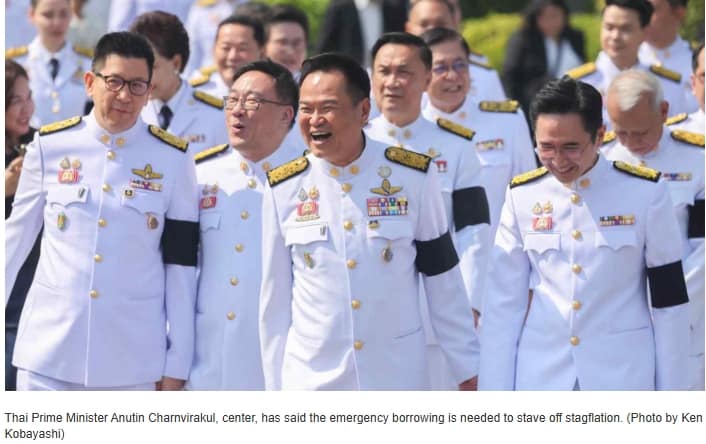
Prime Minister Anutin Charnvirakul has defended the borrowing plan as a necessary intervention to “prevent economic weakening” and steer the country through an unprecedented external shock. Yet the path ahead remains uncertain. Much will depend on the duration of the conflict and Thailand’s ability to shield its economy from prolonged global instability.
For now, the borrowing plan underscores the scale of the crisis—and the difficult choices confronting policymakers in one of Southeast Asia’s most exposed economies.

