


Across Africa, economic growth continues to tell a story of resilience, ambition, and transformation. Yet beneath the surface of expanding GDP figures and development projections lies a persistent vulnerability that threatens to slow the continent’s progress: rising sovereign debt.
While many African economies are recording impressive growth rates, economists warn that the real challenge is not growth itself, but sustainability under mounting debt pressures. When national borrowing becomes too heavy, even strong economic performance may not be enough to prevent fiscal strain.
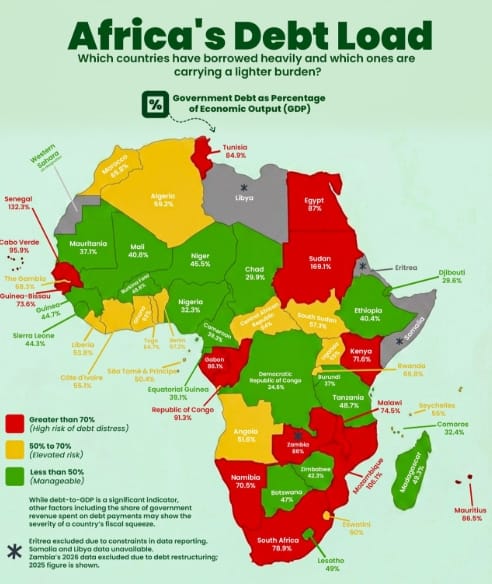
Countries such as Senegal and Zambia are already grappling with significant debt burdens. Others, including Egypt, Kenya, Mauritius, and several additional economies, are facing similar pressures as debt-servicing obligations increasingly compete with essential public spending. South Africa, one of the continent’s largest economies, continues to confront a difficult combination of low growth and elevated debt levels, limiting fiscal flexibility and long-term investment capacity.
According to International Monetary Fund data, government debt across sub-Saharan Africa averages around 56 percent of GDP. While this level is considered manageable in global terms, it masks wide disparities between countries. Many remain in the “green” or “yellow” risk zones, but a growing number are moving into high-risk territory, where debt levels approach or exceed 100 percent of national economic output.
At such thresholds, governments face a narrowing fiscal space. A larger share of public revenue is directed toward interest payments and debt servicing, leaving fewer resources for education, healthcare, infrastructure development, and social protection systems. In practical terms, countries become more focused on financial survival than on long-term investment and development planning.
This dynamic creates a structural challenge: the more resources allocated to debt repayment, the less available for the very investments needed to stimulate future growth. Over time, this can create a cycle where slow growth and high debt reinforce each other.
Oil-exporting nations present a somewhat more stable outlook. With an average debt-to-GDP ratio of approximately 40.9 percent, these economies are comparatively better positioned. Recent increases in global oil prices have also provided additional fiscal breathing room, offering short-term relief and improved revenue inflows.
However, analysts caution that commodity dependence alone cannot serve as a long-term safeguard. Volatility in global energy markets means that oil revenues can fluctuate sharply, exposing economies to sudden fiscal shocks.
The broader economic message is clear: Africa’s growth narrative remains strong, but it is increasingly intertwined with the challenge of debt sustainability. Without structural reforms, expanded domestic revenue bases, and more efficient public spending, the continent risks repeating historical cycles where borrowing constraints limit development potential.
Strengthening tax systems, improving fiscal discipline, and ensuring that borrowed funds are directed toward productive investments will be essential to maintaining economic momentum. The future of Africa’s growth story will depend not only on how fast economies expand, but on how wisely they manage the debts that accompany that growth.