



The political fault lines inside the Labour Party have widened sharply as Greater Manchester Mayor Andy Burnham signals a dramatic return to frontline national politics, setting the stage for what could become one of the most consequential leadership challenges in recent British political history.
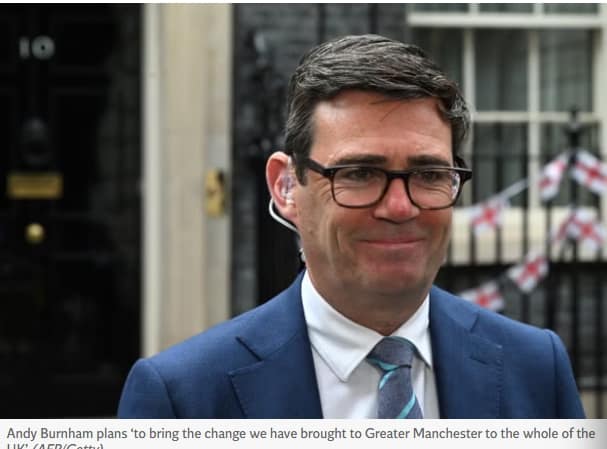
Burnham has confirmed he will seek to return to Parliament, triggering immediate speculation that he is positioning himself for a future bid for Downing Street. The move comes at a moment of heightened instability within Labour, with Sir Keir Starmer facing growing internal dissent and renewed questions about his leadership authority.
The immediate opening has emerged in the constituency of Makerfield, after former Starmer ally and minister Josh Simons announced he would step down as Member of Parliament, clearing the way for Burnham to contest the seat in a likely by-election. The decision is being interpreted within Westminster as a carefully orchestrated political transition, though both camps insist the process remains procedural.
However, Burnham’s path back to Parliament is far from guaranteed.
The Labour Party’s National Executive Committee (NEC) retains the power to block or delay candidate selections, and insiders suggest there is deep unease among sections of the party establishment about Burnham’s return. Some senior figures view his re-emergence as a direct challenge to Starmer’s authority at a time when Labour is attempting to maintain discipline in government and present a unified front.
A senior Labour source said privately: “This is not just about one seat. It is about whether the party is entering a new phase of internal competition at the very top.”
Burnham, often dubbed the “King of the North” for his strong base in Greater Manchester and his outspoken criticism of Westminster politics, has long maintained a delicate relationship with the national Labour leadership. While he previously served as a cabinet minister under Gordon Brown, his departure from frontline politics was widely seen as a retreat from Westminster power struggles—until now.
His return comes at a politically volatile moment for Starmer’s government, which has been struggling with internal divisions, policy pressures and mounting electoral challenges. Reports of tensions within the cabinet have intensified speculation that leadership rivals are beginning to position themselves for a post-Starmer era.
Adding further pressure, Health Secretary Wes Streeting has reportedly stepped back from his departmental role ahead of what some MPs believe could be his own future leadership ambitions. While no formal resignation has been confirmed in Downing Street, his reduced visibility has fuelled talk of a reshaping of Labour’s internal hierarchy.
Meanwhile, opposition forces are already preparing to exploit Labour’s instability.
Nigel Farage, leader of Reform UK, has pledged to “throw everything” into the contest in Makerfield, a seat where Reform performed strongly in recent local and general election cycles. Reform’s strategy is expected to focus on voter disillusionment over cost of living pressures, immigration policy and perceived establishment infighting.
A Reform UK spokesperson said the party sees the by-election as “a chance to show that the old two-party system is breaking down,” adding that Burnham’s candidacy would “not go unchallenged on any front.”
Political analysts say the contest could become a symbolic battleground far beyond a single constituency. Makerfield, traditionally a Labour stronghold, is now viewed as a litmus test for shifting voter loyalties in post-industrial England, where Labour’s dominance has weakened in recent years.
If Burnham wins the seat, he would be eligible to return to Westminster and potentially position himself as a leadership contender. However, insiders caution that winning a by-election is only the first hurdle in a much larger political calculation.
One Labour strategist described the situation as “a slow-burning leadership crisis hiding in plain sight,” noting that Burnham’s popularity in the North of England contrasts with Starmer’s stronger base in metropolitan and professional voter blocs.
The broader question now facing Labour is whether internal competition will strengthen or fracture the party’s electoral position. Some MPs believe a controlled leadership challenge could revitalise Labour’s public appeal, particularly in northern constituencies where economic discontent remains high. Others warn it risks reopening divisions the party has spent years trying to close.
For Starmer, the challenge is immediate and strategic. Maintaining unity within the party while managing visible leadership speculation will require careful political balancing. Downing Street has so far declined to comment on Burnham’s plans, but aides insist the Prime Minister remains focused on governance rather than internal party dynamics.
Yet the political atmosphere in Westminster suggests otherwise. Conversations across parliamentary corridors increasingly revolve around succession scenarios, potential leadership contests, and the possibility of a realignment within Labour’s power structure.
Burnham’s return, if successfully executed, could mark the beginning of a prolonged internal struggle for the soul and direction of the Labour Party. What begins as a constituency by-election may ultimately evolve into a defining battle over who leads Britain’s largest centre-left party into the next general election.
For now, the contest is only just beginning—but its implications already extend far beyond Makerfield.

