




After a quarter of a century forced into exile, 72-year-old George Lee, a member of the Windrush Generation, will finally return to the United Kingdom on Tuesday, 22nd July 2025, arriving at Birmingham Airport in the late afternoon.
Mr Lee, born in Clarendon, Jamaica, came to the UK in 1961 at age 8 to join his parents. Raised and educated in Britain, he attended grammar school and then secured a job in the City of London. Seeking a different path, he later left the corporate world to pursue hairdressing before fulfilling his true passion: teaching English. He taught in Hastings, a career that eventually led him to accept a two-year English teaching contract in Poland in 1997.
For decades, Mr Lee lived, worked, married, and raised a family in Britain. The UK was indisputably his home.
However, when his contract in Poland ended, and he sought to return to Britain, the British Embassy in Warsaw told him he had no entitlement to re-enter the country. Despite decades of lawful residence, he was denied the right to come home — effectively exiled.
For 25 years, Mr Lee lived in Poland under harsh conditions, battling bureaucratic limbo, isolation, and the long-lasting effects of the UK’s hostile environment policy. Subjected to a foreign hostile environment that led to exploitation, he has not seen a doctor for 20 years and was denied access to basic support such as accommodation, medical care, and state benefits.
Now, thanks to the tireless efforts of Bishop Dr Desmond Jaddoo MBE of the Windrush National Organisation and the Windrush Movement UK, Mr Lee’s status has finally been recognised under the Windrush Scheme. He was welcomed back to the UK after a quarter-century in enforced exile.
“This return is a moment of justice long overdue,” said Bishop Dr Desmond Jaddoo MBE. “Mr Lee’s case reveals the international cost of the Windrush scandal and the urgent need to put right the wrongs committed against people who were abandoned by the very country they helped build.”
Bishop Jaddoo added, “George’s ordeal exposes a new dimension to the Windrush scandal — being effectively exiled in a third country, neither his place of birth nor his home. His repeated appeals for help to British consulates in Kraków and Warsaw were met with indifference. He was turned away, his plight ignored, and no records kept. Sadly, this is not an uncommon experience.”
“This demands further scrutiny, especially around diplomatic failures, and urgent, global reform led by organisations like the Windrush National Organisation.”
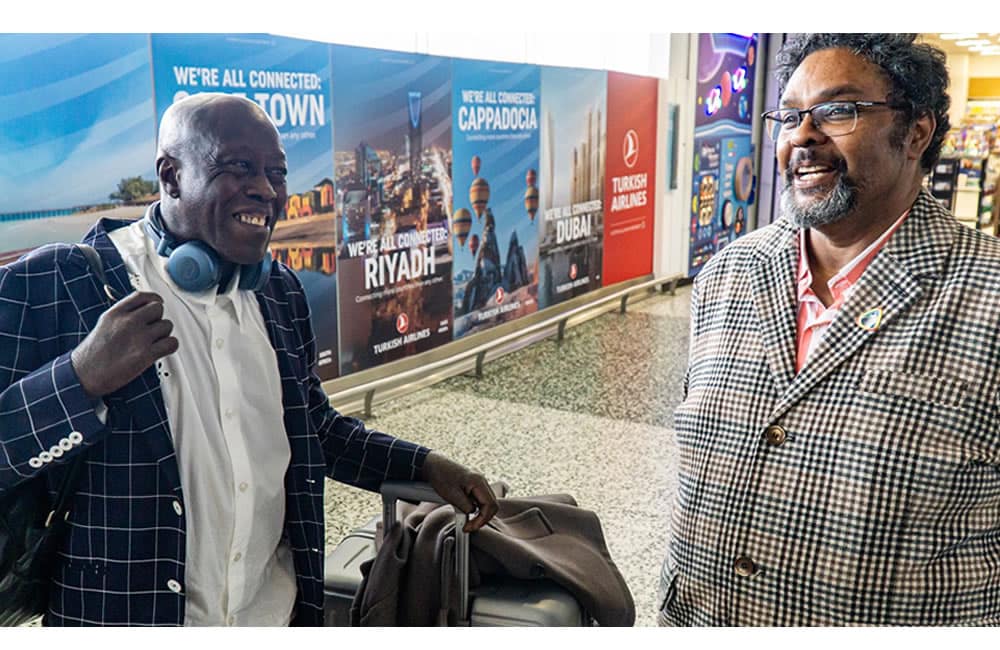
Upon meeting George Lee at Birmingham Airport, Bishop Jaddoo greeted him with the words, “Welcome home.” Mr Lee’s simple but powerful reply echoed decades of resilience: “I’m back.”
Asked if he was glad to be home, George’s answer was measured and heartfelt:
“Not yet. Maybe I will be, once my rights are fully reinstated.”
For Mr Lee, returning to Britain is only the first step. After 25 years living under Poland’s hostile environment — a foreign mirror of the UK’s policies — he faces enormous challenges reintegrating into a society that once rejected him.
At 72, he must now fight to access basic support he has long been denied: his rightful state pension, accommodation, a bus pass, and medical attention. He has not seen a doctor in two decades, a stark reminder of the exploitation and isolation he endured.
“The hostility I faced in Poland, being treated as an outsider with no rights, was a cruel extension of the policies that forced me out of the UK in the first place,” Mr Lee said. “I was exploited because I was vulnerable. Now I’m here, but the struggle is far from over. Until I can get my pension, find a home, and access healthcare, I can’t say I’m truly home.”
Reflecting on his life, Mr Lee shared,”As a child growing up in Jamaica, we looked up to Britain. I was excited when I came to the UK. I was educated here, worked, raised a family — and now I feel utterly betrayed by Britain.”
“Every day for 25 years, I woke with uncertainty. In Poland, I was a citizen of nowhere. I felt invisible, unwanted, erased. I had nowhere to go and nowhere to turn.”
“I haven’t been back to Jamaica since arriving as a child. I’ve spent more than half my life in Britain, yet I was treated as if I didn’t belong. I still ask myself: why me? All I did was take a job overseas. I wanted to work.”
“I want justice, not just for me, but for many still stranded abroad, forgotten. I have a right to be here. I was born in the UK when Jamaica was still a colony. I came here on my aunt’s British passport — only to be told decades later I wasn’t a citizen and had my rights taken away. I want those rights back.”
The Windrush scandal, uncovered in 2018, revealed that hundreds — possibly thousands — of lawful UK residents, mostly from Caribbean countries, were wrongfully detained, denied rights, threatened with deportation, or removed. Many arrived as children under the 1948 British Nationality Act, which gave them the right to settle as British subjects.
The scandal caused national outrage and led to the resignation of then-Home Secretary Amber Rudd. The government introduced the Windrush Compensation Scheme and the Windrush Scheme to restore citizenship status. Yet both have faced widespread criticism for delays, low payouts, bureaucracy, and a lack of trust.
George Lee’s story is a stark reminder that seven years on, the scandal’s wounds remain open. His case highlights ongoing failures in the UK immigration system — not only for those in the country but for those forcibly exiled, out of sight and forgotten.
“The fact George was lost in the system for over 20 years and only now allowed to return shows how far we still must go,” said Bishop Jaddoo. “This is not just history. It is a global, present-day injustice. We must demand real reform, not just apologies.”
As George Lee reintegrates into British life, once more, his words echo the pain of a generation still waiting for restoration, “I want my rights back. I want my dignity back. And I want others like me to finally be seen and heard.”

