




Nigeria has achieved a major milestone in its energy infrastructure with the successful completion of the River Niger crossing on the Obiafu-Obrikom-Oben (OB3) gas pipeline, a development widely seen as transformative for the country’s domestic gas distribution and long-term energy security.
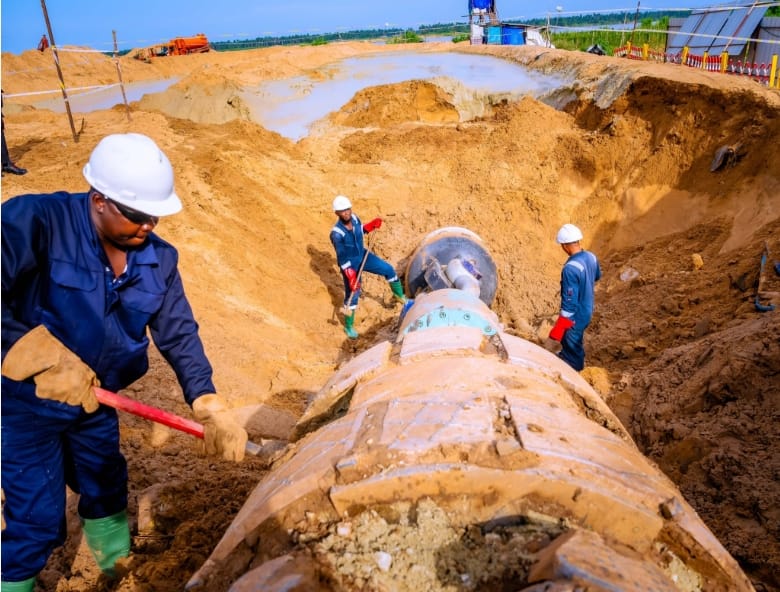
The landmark engineering feat, delivered by the Nigerian National Petroleum Company Limited through its subsidiary, the NNPC Gas Infrastructure Company (NGIC), marks the completion of one of the most technically demanding components of the 130-kilometre OB3 pipeline project. The crossing was executed using advanced horizontal directional drilling (HDD) technology, with the pipeline installed approximately two kilometres beneath the River Niger.
With this breakthrough, Nigeria has effectively unlocked the full operational capacity of the OB3 pipeline, which is designed to transport up to 2 billion standard cubic feet of gas per day. The development is expected to significantly enhance the country’s gas supply chain, connecting previously fragmented networks and improving reliability across regions.
The OB3 pipeline has long been regarded as a strategic backbone project within Nigeria’s energy architecture. Originally conceived over a decade ago, the project was designed to bridge the gap between the country’s eastern and western gas networks. However, progress was slowed by a combination of funding challenges, technical complexities—particularly the River Niger crossing—and security concerns in parts of the Niger Delta.
Over time, the project evolved into a national priority, forming a key pillar of Nigeria’s gas master plan and its ambition to build an integrated and resilient domestic gas grid. The successful completion of the crossing now represents a turning point, enabling seamless transmission of gas across the country.
“This is a defining milestone for Nigeria’s gas infrastructure,” said Bayo Ojulari. “It reflects not only technical excellence but also disciplined execution and our growing capacity to deliver complex energy projects.”
Ojulari noted that the achievement builds on earlier successes, including the River Niger crossing for the Ajaokuta-Kaduna-Kano pipeline completed in 2025. “These milestones demonstrate that Nigeria can execute world-class infrastructure projects, even in challenging environments,” he added.
The interconnection of eastern and western gas networks is expected to have far-reaching economic implications. By improving supply stability, the OB3 pipeline will support increased gas utilisation for power generation, industrial activities, and manufacturing. In the near term, the project is projected to unlock over 500 million standard cubic feet of incremental gas supply, providing a significant boost to domestic energy availability.
Industry analysts say the development could also play a critical role in reducing gas flaring, a long-standing environmental and economic challenge in Nigeria’s oil and gas sector. By creating more efficient pathways for gas evacuation and utilisation, the infrastructure aligns with broader efforts to transition toward cleaner and more sustainable energy sources.
The OB3 pipeline is also strategically linked to the Ajaokuta-Kaduna-Kano (AKK) pipeline, extending gas connectivity to northern Nigeria and reinforcing the country’s ambition to achieve nationwide energy integration. Together, these projects form the backbone of a more robust gas transmission system capable of supporting long-term growth.
Beyond domestic impact, the project strengthens Nigeria’s position in regional energy markets. As demand for natural gas continues to grow across West Africa and beyond, enhanced infrastructure could enable the country to play a more prominent role in cross-border energy trade.
Ojulari commended Bola Tinubu, project partners, and host communities for their contributions to the successful delivery of the project. “This achievement would not have been possible without the support and collaboration of all stakeholders involved,” he said.
The completion of the River Niger crossing also aligns with the federal government’s broader energy targets. Nigeria aims to increase gas production to 12 billion standard cubic feet per day by 2030, positioning gas as a central pillar of its energy transition strategy.
As the country seeks to balance economic growth with sustainability, investments in gas infrastructure are expected to play a crucial role. The OB3 pipeline, now fully operational, stands as a symbol of that ambition—linking regions, unlocking resources, and laying the foundation for a more secure and integrated energy future.
“This project is not just about infrastructure,” Ojulari emphasised. “It is about powering industries, supporting communities, and driving Nigeria’s economic transformation.”

