



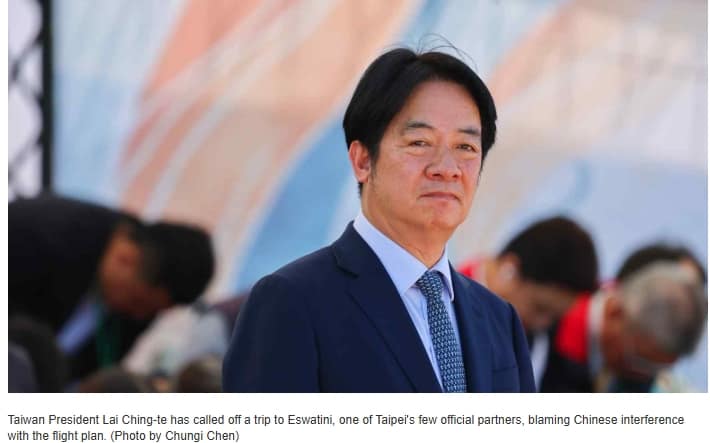
Lai Ching-te has abruptly cancelled a planned diplomatic visit to Eswatini, citing what officials in Taipei describe as mounting “coercion” from China and logistical barriers imposed by third countries.
The visit, which had been scheduled at short notice, was intended to reinforce ties with one of Taiwan’s few remaining formal diplomatic allies. Eswatini is the only country in Africa that maintains official relations with Taiwan, making the trip symbolically and strategically significant for Taipei as it seeks to sustain its shrinking list of global partners.
However, the trip was scrapped at the eleventh hour after what Taiwanese officials say were unexpected refusals by several countries to grant overflight or transit permissions. While no specific nations were officially named, Taipei has suggested that the decisions were influenced by pressure from Beijing.
A senior Taiwanese official stated:
“This is a clear example of how external pressure is being used to limit Taiwan’s international engagement. It goes beyond diplomacy—it is about restricting our ability to connect with our partners.”
China, which views Taiwan as part of its territory, has consistently opposed any form of official interaction between Taipei and other governments. In recent years, Beijing has intensified efforts to isolate Taiwan diplomatically, persuading several countries to switch recognition from Taipei to Beijing.
The cancellation of Lai’s trip highlights the practical challenges Taiwan faces in conducting diplomacy, particularly when it involves long-distance travel requiring multiple transit approvals. Even when destinations are willing to host Taiwanese leaders, the logistics of international airspace access can become a significant obstacle.
Analysts say the incident reflects a broader pattern of geopolitical pressure that extends beyond formal diplomatic recognition into operational constraints.
A regional affairs expert noted:
“This is not just about who recognises Taiwan—it’s about who is willing to facilitate its engagement. Control over airspace and transit routes has become a subtle but powerful tool of influence.”
Despite the setback, Taiwanese officials have reaffirmed their commitment to strengthening ties with allies and expanding informal partnerships around the world. Eswatini, for its part, has remained a steadfast supporter of Taiwan, with both sides emphasising the importance of continued cooperation.
In a statement, Taiwan’s foreign ministry expressed regret over the cancellation but reiterated its intention to maintain high-level engagement with its partners through alternative channels.
China has not directly commented on the specific incident but has repeatedly stated its opposition to what it calls “official exchanges” between Taiwan and other countries. Beijing maintains that nations should adhere to the “One China” principle, which recognises the People’s Republic of China as the sole legitimate government of China.
The episode comes at a time of heightened tension across the Taiwan Strait, with increasing military activity, diplomatic competition, and strategic rivalry shaping regional dynamics.
For Taiwan, the cancellation of the Africa trip is more than a logistical setback—it is a reminder of the constraints it faces on the global stage. For its allies, it underscores the complexities of maintaining relationships in a highly contested geopolitical environment.
As Taipei recalibrates its diplomatic approach, the incident is likely to fuel further debate about how smaller states navigate pressure from major powers, and how international norms around access and engagement are evolving in an increasingly polarised world.
Whether this episode leads to greater resilience in Taiwan’s diplomatic strategy or further limitations on its global outreach remains to be seen. For now, it stands as a clear illustration of how geopolitics can shape even the most routine aspects of international engagement.

