




United States President Donald Trump has unveiled an ambitious proposal to convene a summit between Russian President Vladimir Putin and Ukrainian President Volodymyr Zelenskyy, in what he describes as a “first serious step” toward ending the devastating conflict that has defined Eastern Europe for nearly four years.
The announcement came on Monday during a high-profile gathering at the White House that included Zelenskyy and several European leaders, among them French President Emmanuel Macron, UK Prime Minister Keir Starmer, German Chancellor Friedrich Merz, and NATO Secretary-General Mark Rutte. The talks, centered on the war and the long-debated issue of security guarantees for Ukraine, underscored the urgency of finding a political settlement to a conflict that has claimed thousands of lives and destabilized the global order.
Trump revealed that he had already spoken directly with Putin by phone and that arrangements were “underway” for a face-to-face meeting between the Russian and Ukrainian leaders. “This was a very good, early step for a war that has been going on for almost four years,” Trump posted on his Truth Social platform. He added that Vice President JD Vance, Secretary of State Marco Rubio, and Special Envoy Steve Witkoff were leading U.S. coordination with Moscow and Kyiv.
Although Moscow has yet to officially confirm participation, Russia’s state-run TASS news agency cited Kremlin aide Yuri Ushakov as saying that Putin and Trump agreed on the value of continuing direct dialogue between the two sides. For his part, Zelenskyy struck a cautious but optimistic tone after his meeting with Trump, calling it a “very good conversation” and affirming he was “ready” to meet Putin one-on-one.
At the heart of the discussions was the thorny question of security guarantees for Ukraine—measures that Kyiv insists are essential if any peace deal is to be credible. Trump suggested that European nations would take the “first line of defense” in providing such assurances, but emphasized that the United States would remain heavily involved. “We’re going to help them out also, we’re going to be involved,” he told reporters, later clarifying online that Washington’s role would be one of “coordination.”
NATO’s Mark Rutte described the U.S. willingness to play a coordinating role as a “breakthrough,” though he admitted the details were still under negotiation. “What we all agree on is that if this war does come to an end, it has to be definitive,” he said. Still, he ruled out the immediate prospect of U.S. or European troops being deployed to Ukraine.
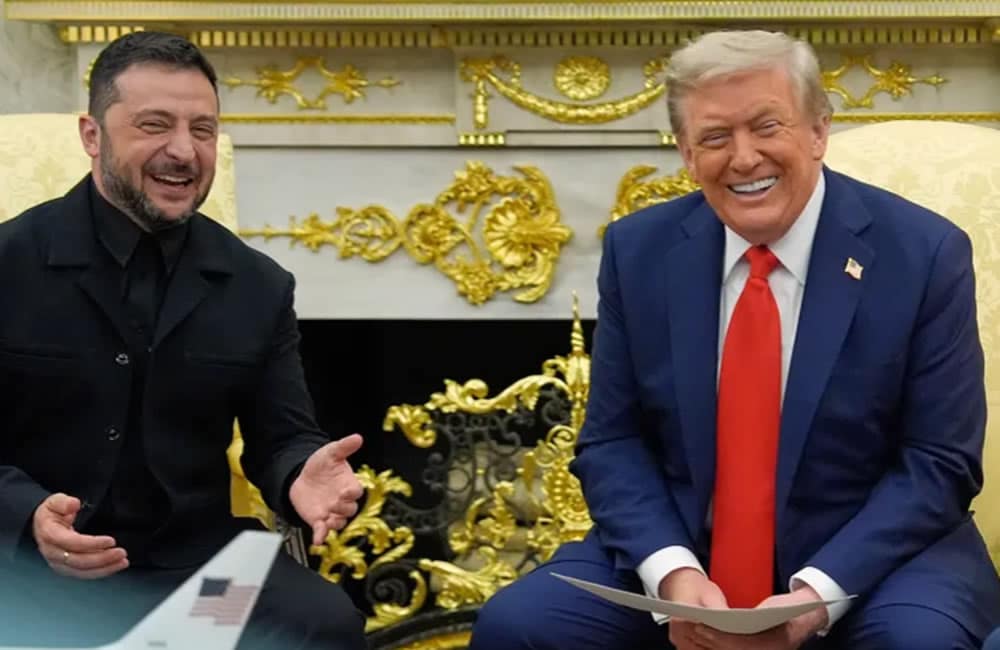
US President Donald Trump meets with Ukrainian President Volodymyr Zelenskyy in the Oval Office at the White House, in Washington, DC, [Julia Demaree Nikhinson/AP]
Analysts remain divided on whether Trump’s initiative can succeed where previous diplomatic overtures have failed. Konstantin Sonin, a Russian exile and professor at the University of Chicago, cautioned that written guarantees alone would not be enough. “Ukraine has been failed by ‘written’ guarantees for decades,” he said, pointing to Russia’s violation of agreements signed as recently as 2004. “The sticking point is not the language in some documents—it is enforcement. Without European troops on the ground, Putin will not see the guarantees as serious.”
Another complication looms over the negotiations: territory. Russia currently occupies roughly one-fifth of Ukraine, and Trump has signaled that Kyiv may need to accept compromises on land in order to settle. “Obviously, land or where you draw those lines—where the war stops—is going to be part of that conversation,” Secretary of State Marco Rubio said. He acknowledged the difficulty but argued it was “what it takes in order to bring about an end to a war. And that’s been true in every war.”
Zelenskyy, however, has repeatedly rejected the idea of surrendering Ukrainian territory. On Monday, he reiterated that territorial questions would only be decided directly between him and Putin. “We will leave the issue of territories between me and Putin,” he told reporters, making clear that Ukraine would not concede its sovereignty lightly.
Yurii Poita of the Kyiv-based Center for Army, Conversion and Disarmament Studies said the White House meeting represented cautious progress for Ukraine. “While ‘security guarantees’ previously demanded by Kyiv irritated the U.S., we now see that the parties are beginning to work on the outlines of these guarantees, and the broader security architecture that would ensure long-term peace,” he said. Still, Poita warned that without sustained pressure on Russia, particularly through economic sanctions, Moscow might stall or impose unacceptable conditions.
Despite the unresolved complexities, Trump’s proposal marks the closest the warring parties have come to direct negotiations since the invasion began in February 2022. If realized, a Putin-Zelenskyy summit could become the pivotal moment that determines whether Europe moves toward peace—or slides deeper into prolonged instability.
As Rutte put it, “If this war does come to an end, it has to be definitive.”

