




The United Kingdom is preparing to sign a significant new defence and security treaty with Poland, marking a major step forward in bilateral cooperation amid growing geopolitical tensions across Europe. The agreement is expected to deepen military collaboration, enhance cyber defence capabilities, and strengthen joint responses to emerging hybrid threats.
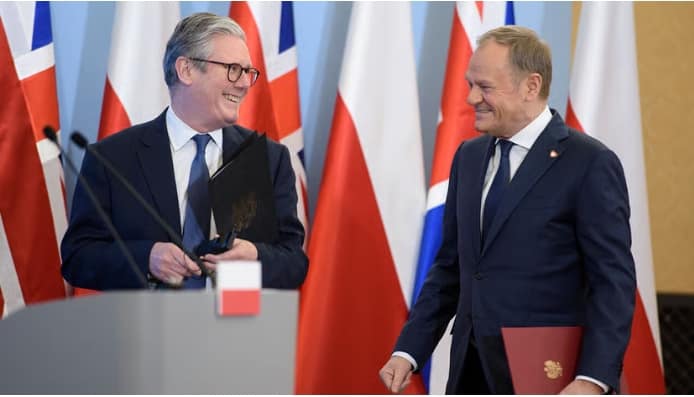
Officials from both countries describe the pact as a strategic response to an increasingly complex security environment, shaped by cyberattacks, disinformation campaigns, and heightened military risks on Europe’s eastern flank. The agreement is also seen as a continuation of the UK’s post-Brexit effort to reinforce its security partnerships across the continent while maintaining a leading role within NATO.
Under the proposed framework, the UK and Poland are expected to expand joint military exercises, increase intelligence sharing, and develop coordinated strategies to protect critical infrastructure, including energy networks, communications systems, and transport corridors. Cybersecurity is set to be a central pillar of the agreement, with both nations committing to closer collaboration between their respective defence cyber units.
Poland, which shares a border with Ukraine and has been one of the most vocal supporters of strengthening NATO’s eastern defences, views the partnership as a vital reinforcement of its national security posture. The UK, meanwhile, sees Poland as a key strategic ally in Central and Eastern Europe, particularly in light of ongoing security concerns linked to regional instability and hybrid warfare tactics.
Defence analysts suggest the treaty reflects a broader shift in European security architecture, where bilateral agreements are increasingly complementing multilateral NATO structures. The move is also interpreted as a signal of long-term commitment by the UK to continental security cooperation, despite evolving political dynamics within Europe.
The agreement is expected to include provisions for joint research and development in advanced defence technologies, including cyber defence systems, artificial intelligence applications in security, and next-generation surveillance capabilities. Military training exchanges and officer development programmes are also anticipated to form part of the deal.
While the treaty has been broadly welcomed by defence experts, some commentators caution that increased militarisation and cyber escalation risks could heighten tensions with adversarial states. Nonetheless, both governments maintain that the pact is defensive in nature and aimed at deterrence, stability, and resilience.
The signing is expected to take place in the coming weeks, with senior ministers from both countries highlighting the importance of unity and preparedness in an increasingly uncertain global security landscape.

