




On a bright Monday morning in Dudley, the usually busy corridors of Russells Hall Hospital had an extra buzz. Staff were not only caring for patients but also showcasing a quiet revolution in healthcare. Health Minister Stephen Kinnock was in the building, eager to see how artificial intelligence is transforming the way the NHS delivers life-saving care.
In the hospital’s stroke unit, clinicians demonstrated RapidAI – a cutting-edge technology that has been nothing short of a game changer. For stroke patients, every second can mean the difference between full recovery and life-long disability. RapidAI slashes the time from symptom onset to treatment by as much as an hour.
The system instantly processes diagnostic brain scans and produces preliminary reports, allowing clinicians to confirm a stroke diagnosis and act almost immediately. Crucially, it can also flag patients whose symptoms aren’t textbook – no slurred speech or drooping face – but whose scans reveal hidden dangers.
Mr Kinnock, watching the demonstration, remarked,“This use of AI can cut the time between someone showing symptoms of stroke and receiving treatment by up to an hour – a potentially life-saving improvement. When it comes to strokes, every second counts.”
Since Dudley Group NHS Foundation Trust introduced the system in May 2024, patients have been receiving diagnoses within 40–60 minutes – significantly faster than before.
For Diane Wake, the Trust’s Chief Executive, the impact is already visible ,“Using artificial intelligence is making a real difference to how quickly we can diagnose and treat patients – especially in critical areas like stroke care. It’s helping our teams make faster decisions, improve outcomes, and spend more time with the people who need them most.”
But the Minister’s visit wasn’t just about stroke care. Upstairs, in a quieter part of the hospital, another digital innovation is changing lives, particularly for children.
The Paediatric Virtual Ward allows young patients with conditions like asthma, RSV, or post-viral complications to receive hospital-level monitoring without leaving their homes. Instead of long days in a hospital bed, children are surrounded by their toys, their own bed, and the reassuring presence of family.
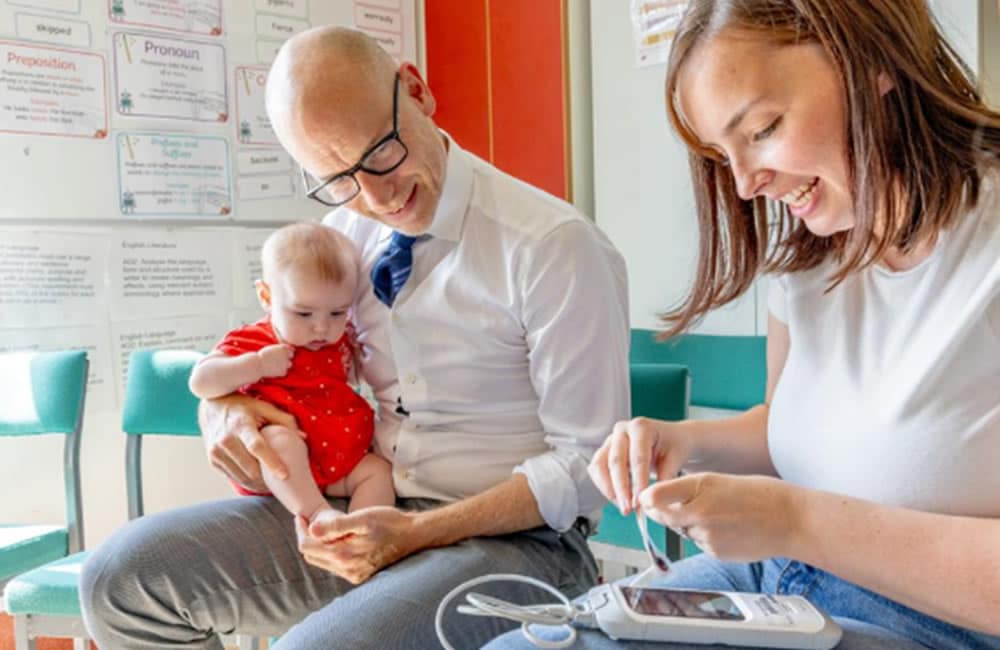
Here’s how it works: when a child’s condition is stable enough, they are discharged with a tablet device linked directly to the hospital team. Parents or carers enter vital signs – temperature, oxygen levels, heart rate – and can message or video call clinicians at any time. If anything changes, the team can act immediately.
Over the past year, this digital ward has treated over 500 children and saved nearly 2,000 bed days. That’s not just a number – it’s hundreds of nights where children slept in their own bedrooms instead of a hospital ward.
One mother, whose eight-year-old son recovered from a severe asthma attack at home thanks to the virtual ward, described the experience as “life-changing”:
“He was scared in the hospital, but once we were home, he relaxed. I knew the doctors were still keeping a close eye on him. It meant we could keep our family together, and he got better faster.”
For Mr Kinnock, this is exactly what the government’s 10 Year Health Plan aims to achieve – faster treatment, more personalised care, and the sharing of best practice across the NHS. “Artificial intelligence and digital technology are central to modernising our NHS. The plan is all about taking the best of the NHS to the rest of the NHS. We want innovations like these to be standard, so patients everywhere can benefit,” he said.
Back in the stroke unit, a senior nurse reflected on the changes: “Before, we’d be running to get results, calling people, waiting for reports. Now, the scan’s done, and the AI gives us a clear flag. We can move straight to treatment. That’s what saves lives.”
From potentially preventing lifelong disabilities in stroke patients to letting sick children heal at home, Dudley’s embrace of digital health is showing how technology, when used wisely, can put compassion at the centre of care.
For the staff at Russells Hall Hospital, it’s simple – these aren’t just machines. They’re tools that give them back the most precious thing in medicine: time.

