




Small businesses across South Korea are facing mounting pressure as Coupang—often dubbed the country’s answer to Amazon—continues its rapid expansion, reshaping retail and logistics in ways that are both transformative and deeply disruptive.
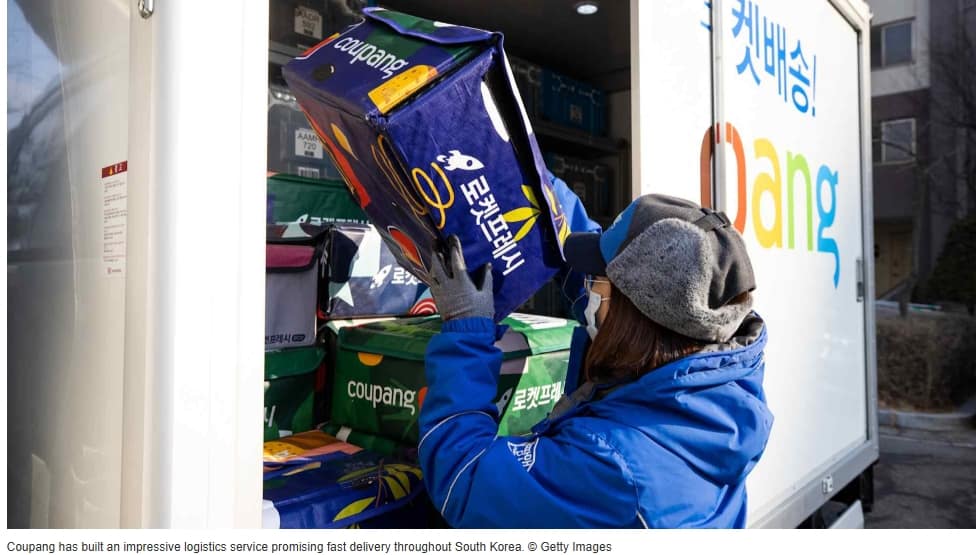
Over the past decade, Coupang has revolutionised online shopping in South Korea through its ultra-fast delivery model, competitive pricing, and vertically integrated logistics network. Its “Rocket Delivery” service, which promises same-day or next-day shipping, has set new consumer expectations and forced traditional retailers to adapt or risk irrelevance.
However, this transformation has come at a cost.
For many small and medium-sized enterprises (SMEs), competing with Coupang’s scale, pricing power, and infrastructure has proven increasingly difficult. Independent retailers and family-owned shops say they are being squeezed out of the market, unable to match the convenience and cost efficiencies offered by the e-commerce giant.
A small business owner in Seoul described the challenge bluntly:
“We are not just competing with another company—we are competing with an entire system that controls pricing, delivery, and visibility. It’s almost impossible to keep up.”
The growing dominance of Coupang has sparked a wider debate among regulators and policymakers about market fairness, competition, and the long-term impact on South Korea’s economic ecosystem. Critics argue that the company’s aggressive expansion risks creating an uneven playing field, where smaller players are gradually marginalised.
Regulatory authorities have begun examining aspects of Coupang’s business practices, including its relationships with suppliers, pricing strategies, and market influence. Some lawmakers have called for stronger oversight to ensure that competition remains fair and that smaller businesses are not disproportionately disadvantaged.
A policy analyst noted:
“The issue is not innovation—Coupang has clearly driven progress. The question is whether that progress is inclusive or whether it concentrates power in ways that weaken the broader economy.”
Coupang, for its part, maintains that its growth benefits both consumers and businesses. The company argues that it provides a platform for smaller sellers to reach wider audiences and that its logistics network creates efficiencies that ultimately support economic activity.
In statements, the company has highlighted its role in job creation, investment in infrastructure, and support for third-party vendors. It also points to the increasing number of small businesses using its platform to scale beyond traditional retail limitations.
Yet, the relationship between Coupang and small sellers remains complex. While some businesses have thrived by leveraging the platform, others say they face high commission fees, intense competition, and limited control over pricing and customer relationships.
The tension reflects a broader global trend, where large digital platforms are redefining commerce while raising questions about market concentration and economic balance.
In South Korea, the stakes are particularly high. The country’s economy has long relied on a mix of large conglomerates and vibrant small business activity. If SMEs continue to struggle, analysts warn, it could have implications for employment, innovation, and regional economic stability.
A retail industry observer summed up the dilemma:
“Coupang represents the future of commerce, but the future cannot be sustainable if it leaves small businesses behind.”
As regulators, politicians, and industry leaders continue to debate the path forward, one thing is clear: the rise of Coupang is not just a business story—it is a defining moment in South Korea’s economic evolution, forcing the country to confront difficult questions about growth, fairness, and the balance of power in the digital age.

