





The fertility rate in England and Wales has fallen to a record low, underscoring growing demographic concerns despite a slight rise in the number of births. According to data from the Office for National Statistics (ONS), the total fertility rate—the average number of children a woman is expected to have over her lifetime—stood at 1.41 in 2024, down from 1.42 in 2023. This marks the lowest
Level since records began in 1938 and represents the third consecutive annual decline.
Natural population growth has been shrinking for years, and projections suggest that deaths could surpass births by 2030. Despite this, migration has helped offset population decline, with net migration adding 431,000 people to England and Wales in the year to mid-2024. As a result, the population still grew by approximately 706,000, although fertility rates continued to fall due to the growing population denominator. The number of births in 2024 did rise slightly, from 591,072 to 594,677, yet this small increase was insufficient to reverse the downward trend in fertility.
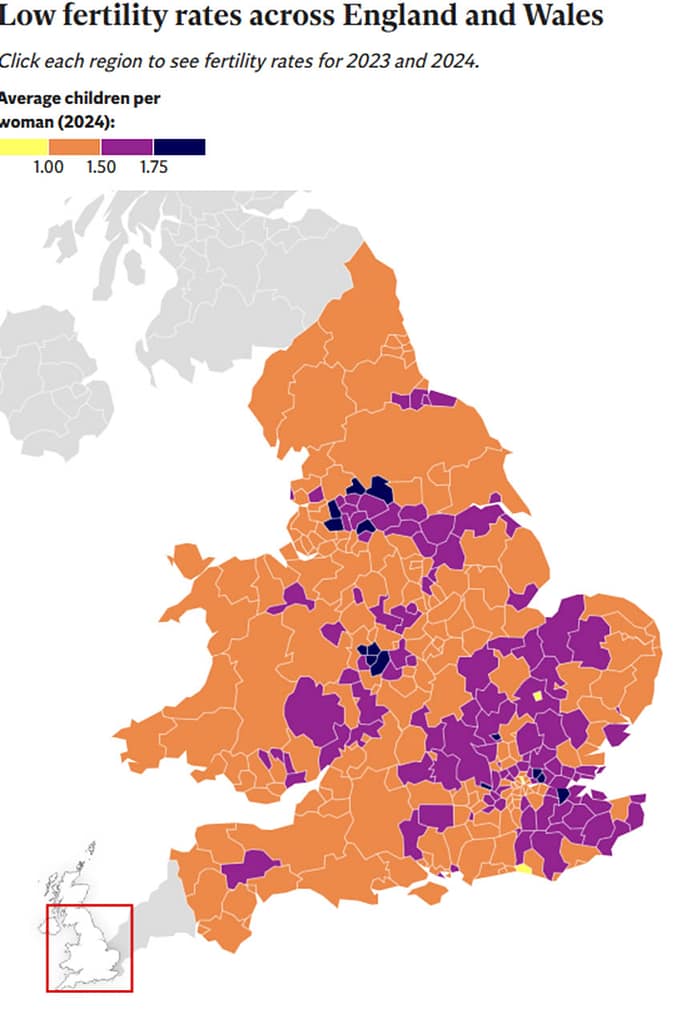
The ONS data reveals stark regional disparities. Luton recorded the highest fertility rate at 2.0 children per woman, while the City of London had the lowest, just 0.32. Across all areas, fertility remains below the replacement level of 2.1, the rate required to maintain a stable population without relying on migration. Scotland also recorded a historic low, with its fertility rate dropping to 1.25 in 2024.
The United Kingdom is experiencing one of the steepest fertility declines among G7 nations. While countries such as Italy and Japan also have low fertility, the UK’s decrease has been sharper and faster. Between 2010 and 2023, the UK’s fertility rate fell by roughly 25%, from 1.92 to 1.44 children per woman.
A contributing factor is the increasing age at which women have children. In 2000, the average first-time mother in England and Wales was just over 26 years old. By 2024, the average has risen to more than 29, with London first-time mothers averaging 31 years old. Women having a second child in the capital typically do so at age 33. This delay reflects broader social and economic trends, including longer periods spent in education, career development, and the financial pressures associated with raising a family.
Fertility rates also vary markedly between urban and suburban areas. Higher fertility tends to cluster around Manchester, Birmingham, and southeastern England, while central London boroughs consistently report some of the lowest rates, hovering around one child per woman. Outlying areas such as Barking and Dagenham have averages close to 1.99, demonstrating that local demographics, housing, and affordability continue to play a major role in reproductive choices.
Over half of all local authorities in England and Wales saw fertility rates decline in 2024, with 185 out of 317 councils recording drops. Conversely, only about one-third of areas reported increases. Some of the most dramatic changes include Maldon, Essex, which fell from 1.59 to 1.37 in a single year, while Birmingham experienced a rise from 1.61 to 1.75 children per woman.
Economic pressures appear to be influencing family planning decisions. A recent Ipsos poll for The Independent found that four in ten couples are delaying children, citing financial constraints as a primary concern. This trend, combined with the continued rise in maternal age, has implications for population structure, long-term workforce numbers, and future economic growth.
Fertility rates in the UK also lag behind the European Union, raising concerns among policymakers and political commentators. Reform Party leader Nigel Farage recently highlighted the issue, proposing measures to boost birth rates, including abolishing the two-child benefit cap. His plan also advocates for stricter migration controls, a move that could compound the UK’s fertility challenge by reducing the contribution of younger, reproductive-age migrants to overall population growth.
In 2024, there were approximately 568,000 deaths in England and Wales. Without the contribution of migration, the population would have barely increased, underscoring the critical role of inward migration in maintaining population numbers.
Demographers warn that continued low fertility could have lasting social and economic consequences, from an aging population to increased pressure on public services and pensions. The current trends suggest that while migration currently offsets natural population decline, the underlying issue of below-replacement fertility persists, driven by economic, cultural, and lifestyle factors that influence decisions about if and when to have children.
As fertility in England and Wales reaches historic lows, the combination of delayed parenthood, regional disparities, and economic pressures highlights a demographic shift with profound implications for the nation’s future population structure, workforce, and social support systems.

