



France President Emmanuel Macron has unveiled €23bn ($27bn) in investment commitments for Africa spanning infrastructure, the energy transition, agriculture, artificial intelligence (AI), healthcare and the cultural and creative industries.
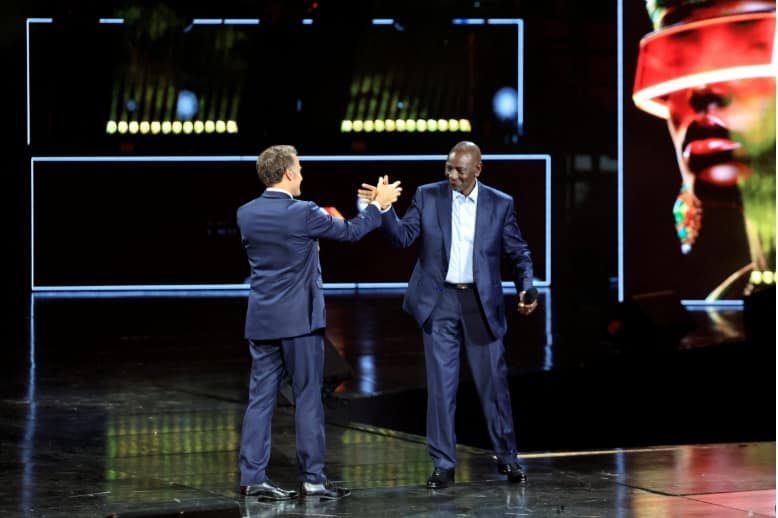
The commitments were unveiled at the Africa Forward Summit in Nairobi, co-hosted by Macron with Kenya President William Ruto. The Summit is being held in an anglophone nation for the first time as France looks to grow economic and diplomatic ties with African countries outside its historical “sphere of influence.”
Shipping and logistics giant CMA CGM signed the Summit’s largest deal: a €700m ($821m) agreement with Kenya to expand capacity at the Port of Mombasa. CMA CGM said the partnership is aimed at modernising freight management systems and improving inland logistics networks.
Meanwhile, Proparco, the private‑sector arm of the Agence Française de Développement (AFD), announced multiple partnerships. These include a €300m ($352m) facility with Ecobank to strengthen agricultural value chains; a €200m cross‑currency facility with the West African Development Bank (BOAD) to ease Euro/CFA franc trade flows; a €300m ($352m) partnership with AXIAN Group targeting telecom connectivity and renewable‑energy expansion; and a €20m ($23.4m) investment in South Africa’s Biovac.
These deals, Macron stressed, turn the old development model on its head. Instead of aid flowing in one direction – and donors dictating to recipients what to do – French investors will co‑invest alongside African investors.
Indeed, of the €23bn that is set to be mobilised, €14bn ($16.4bn) will come from France’s private sector, while African partners will mobilise €9bn ($10.5bn).
France’s pivot from aid to investment reflects both opportunity and necessity. Rising anti‑French sentiment in former colonies has compelled French firms to diversify to other regions of Africa. Many are now seeking growth in stabler, more commercially vibrant anglophone markets. Tellingly, trade data shows that France is doing more business today with English‑speaking economies like Nigeria and South Africa than with its former colonies.
Macron emphasised that France seeks a “partnership of equals” with African countries, which he said face “common challenges” with Europe. “The challenges of Africa and Europe are shared challenges. We all want peace, prosperity and sovereignty,” he noted.
He said that, under his watch, France and Europe more broadly were pushing for fairer representation of African nations in global governance.
“We have been fighting for Africa to have a permanent seat in the G20. We have been fighting for this for years and we have now made it a reality. We are now fighting for Africa to have a seat on the UN permanent security council.”
Ruto lauded France’s approach in Africa, arguing that relations rooted in trade and investment – rather than aid – hold the key to fruitful and enduring ties.
“Africa and France have a unique opportunity to forge a forward‑looking partnership that delivers shared progress while advancing Africa’s long‑term economic transformation,” he said.
“We should no longer think in terms of aid and loans, but rather in terms of investment and what Africa has to offer,” Ruto added, noting that mutual partnerships were a strategic imperative amid deepening geopolitical divisions, climate pressures, and widening inequalities.
“The times before us demand stronger cooperation, renewed multilateralism, and partnerships grounded not on hierarchy, but in sovereign equality, mutual respect and shared responsibility,” Ruto said.
Despite France’s diplomatic charm offensive in Africa, questions linger over whether Paris can counter the rising influence of rivals such as China, Russia, and the United Arab Emirates, which have all amplified their engagement with Africa in recent years.
Pressed on the issue, Nicolas Forissier, France’s minister delegate for foreign trade, avoided direct comparisons. “I am not making any comparisons,” he told journalists in Nairobi. Instead, he stressed Europe’s focus on reliability and long‑term engagement.
“France, and Europe more generally, aims to be a reliable partner that builds win‑win partnerships. We don’t just come, build something and go. We aim for partnerships that are beneficial to African countries and companies,” he said.
Like many Western nations, France has considerably reduced the amount of aid it spends overseas. In 2026, French legislators approved aid spending of €3.5bn ($3.99 bn), an 18% drop from 2025 and a decline of more than €2bn ($2.35 bn) from 2024 levels.
For African governments and companies that rely on foreign aid to plug budget gaps, the cuts have been bruising. President Emmanuel Macron, however, insists that the decline in French aid does not signal a retreat from Africa but an evolution in strategy.
At the Summit, Macron emphasised that France is “in Africa for the long haul.”
Rather than pulling back, Paris is anchoring its diplomatic strategy in investment, partnerships, and commercially‑driven development.
The Summit – France’s first in an English‑speaking country – drew leaders from more than 30 African nations, including Nigeria’s Bola Tinubu, Egypt’s Abdel Fattah el‑Sisi, Ghana’s John Mahama, and Senegal’s Bassirou Diomaye Faye. Also present were UN Secretary‑General António Guterres and African Union Commission chair, Mahamoud Ali Youssouf.
French corporate heavyweights were out in force, underscoring the private sector’s growing role in Paris’s economic diplomacy on the continent. TotalEnergies, Orange, and CMA CGM showcased projects spanning renewable grids, digital infrastructure, and logistics corridors. They shared the stage with African business titans such as Aliko Dangote and James Mwangi of Equity Bank. African SMEs and entrepreneurs were also present in large numbers. Overall, attendance far exceeded expectations. Nearly 7,000 delegates descended on Nairobi, compared with the 2,500 organiser’s had initially targeted.

