



Japan has stepped up its economic and diplomatic engagement across Africa, with a senior Tokyo envoy concluding a multi-country tour that placed Angola’s oil and mineral wealth at the centre of renewed interest in securing long-term resource partnerships.
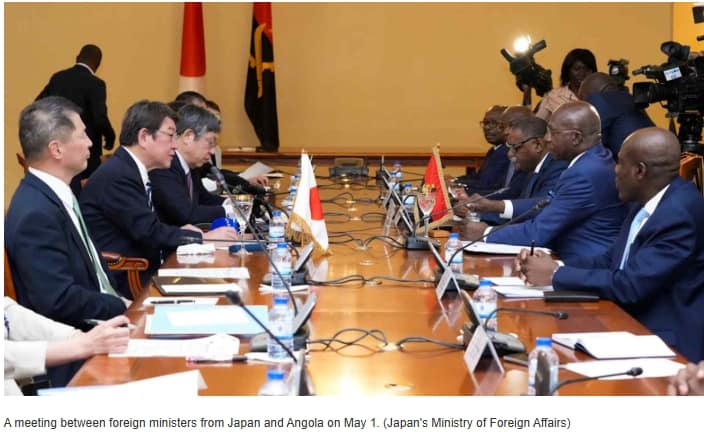
The visit, led by a top Japanese foreign ministry official, included stops in Angola, Kenya, Zambia and South Africa. Officials say the tour was designed to deepen bilateral trade ties, secure critical mineral supply chains, and expand Japan’s strategic footprint in regions where China has traditionally held strong economic influence.
In Angola, discussions focused heavily on offshore crude oil production, natural gas expansion, and the country’s growing importance as a supplier of refined and unrefined petroleum products. Angola remains one of Africa’s largest oil producers, and Tokyo is seeking to diversify its energy imports as part of its long-term energy security strategy.
Japanese officials also expressed strong interest in Angola’s critical minerals sector, particularly copper, cobalt and rare earth elements—resources essential for electric vehicles, semiconductor manufacturing and renewable energy technologies. With global competition intensifying for these materials, Japan is accelerating its efforts to secure stable, politically diversified supply chains.
A senior diplomat involved in the visit said Japan is “committed to building mutually beneficial partnerships that go beyond extraction,” emphasising investment in infrastructure, skills training and local industrial development. The approach reflects Tokyo’s broader “co-creation” model, which seeks to balance resource access with economic development in partner countries.
In Kenya, talks centred on infrastructure development, port logistics and renewable energy cooperation. Japan has long supported major infrastructure projects in the country, including road networks and urban transport systems financed through development assistance programmes. Kenyan officials reportedly welcomed increased Japanese private sector involvement in technology and manufacturing zones aimed at boosting exports.
In Zambia, attention turned to copper production, which remains one of the world’s most important inputs for electrical infrastructure and green technologies. Zambia is among the top global copper producers, and Japan is particularly interested in strengthening supply chain resilience amid rising global demand driven by electrification trends.
Meanwhile, in South Africa—the continent’s most industrialised economy—discussions focused on automotive manufacturing, hydrogen energy development and port logistics. Japanese car manufacturers already maintain a strong presence in the country, but officials are now exploring expansion into electric vehicle supply chains and battery component production.
The tour also reflects broader geopolitical dynamics, as global powers increasingly compete for influence in Africa’s resource-rich economies. China remains the dominant investor in many infrastructure and mining projects across the continent, but Japan, along with the United States and the European Union, is seeking to reassert its presence through targeted investment, technology transfer and diplomatic engagement.
Experts say Japan’s renewed Africa strategy is closely linked to global supply chain realignments triggered by geopolitical tensions, including the war in Ukraine and growing concerns over overreliance on single-source suppliers for critical minerals. By strengthening ties with multiple African economies, Tokyo aims to reduce vulnerability to external shocks.
A policy analyst in Tokyo noted that Japan’s approach is “less about extraction and more about stability,” adding that Japanese firms prefer long-term partnerships that include environmental safeguards and local workforce development. This contrasts with more transactional investment models that have drawn criticism in some regions.
However, challenges remain. African governments are increasingly assertive in negotiating resource deals, demanding greater local processing, job creation and infrastructure development in exchange for access to raw materials. Angola, in particular, has been pushing to expand domestic refining capacity to capture more value from its oil exports.
Japanese firms also face stiff competition from Chinese state-backed companies that often offer faster financing and large-scale infrastructure packages. As a result, Tokyo’s strategy is increasingly focused on high-quality investment rather than volume, targeting niche sectors such as clean energy technology, advanced manufacturing and sustainable mining practices.
Despite these challenges, officials in both Japan and the visited countries described the tour as productive, with several preliminary agreements reportedly reached on future investment frameworks and technical cooperation.
As global demand for energy and critical minerals continues to rise, Japan’s Africa engagement signals a broader shift in international economic diplomacy—one where resource security, technological collaboration and geopolitical positioning are becoming deeply intertwined.


