




Chinese electric vehicle manufacturer Leapmotor is making a bold push into Europe’s most competitive car market, offering German drivers a fully electric vehicle for as little as $57 (€50) per month with no upfront deposit—an aggressive pricing strategy that is shaking up Europe’s automotive industry.
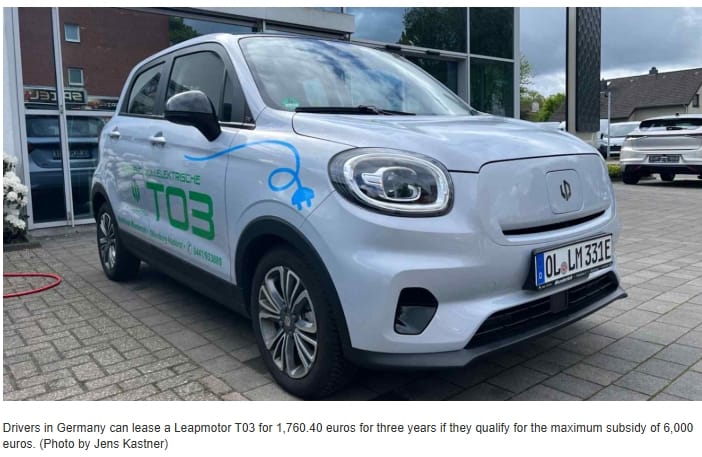
The offer applies to the company’s compact T03 model, a small city EV designed for urban commuting. The deal is being marketed in partnership with European distribution channels and is underpinned by Germany’s green mobility incentives, which reduce upfront leasing costs for eligible low-emission vehicles.
Industry analysts say the combination of Chinese manufacturing cost advantages and European climate subsidies has created a “perfect entry window” for new Chinese EV brands seeking to challenge established German automakers such as Volkswagen, BMW and Mercedes-Benz Group.
The Leapmotor T03 is positioned as a budget-friendly alternative in a segment where prices have traditionally remained high. In Germany, even entry-level electric vehicles often cost between €25,000 and €35,000, placing them out of reach for many first-time buyers. By contrast, the T03 lease structure effectively lowers monthly mobility costs to less than the price of a typical public transport subscription in some German cities.
A spokesperson familiar with the rollout said the pricing strategy is designed to “democratise electric mobility in Europe” and accelerate adoption among younger and urban drivers. “We are not just selling cars; we are offering access to electric driving at a price point that competes directly with daily commuting costs,” the representative added.
A key factor behind the zero-deposit leasing structure is Germany’s evolving green transport policy. Government incentives aimed at reducing carbon emissions continue to support EV uptake, particularly for compact vehicles with low energy consumption. While subsidies have been scaled back in recent years compared to peak pandemic-era support, targeted schemes for low-income and urban drivers still exist in various regional programmes.
The deal also reflects broader shifts in the European automotive landscape. Chinese EV makers have rapidly increased their presence in the continent, leveraging lower production costs, vertically integrated supply chains, and strong domestic battery manufacturing ecosystems. This has allowed them to undercut European rivals on price while still offering competitive driving ranges and digital features.
However, the expansion is not without controversy. European manufacturers have warned that heavily subsidised Chinese imports could distort competition. The European Commission has already launched investigations into state support for Chinese EV exports, raising the possibility of future tariffs or regulatory adjustments.
A senior automotive analyst in Frankfurt noted that the Leapmotor pricing strategy is “disruptive by design.” He said: “If consumers can access a new EV for under €60 a month, it forces legacy automakers to rethink not only their pricing but their entire cost structure. This is not just competition—it is a structural challenge to the European car industry.”
Despite the low price point, the T03 offers standard urban EV specifications, including a modest driving range suitable for city commuting, digital infotainment systems, and compact dimensions designed for tight European streets. However, it is not aimed at long-distance drivers or premium vehicle segments, where German manufacturers still dominate.
Consumer response in Germany has reportedly been strong among younger drivers and first-time EV users, particularly in cities like Berlin, Hamburg and Munich, where environmental awareness and fuel costs are key purchasing factors. Leasing firms involved in the rollout say inquiries have exceeded initial projections, suggesting strong demand for low-cost electric mobility.
Still, questions remain about long-term profitability and market sustainability. Industry experts caution that such aggressive pricing may depend heavily on continued subsidies, favourable exchange rates, and high-volume production efficiencies. Without these factors, maintaining ultra-low monthly payments could prove challenging.
For now, Leapmotor’s entry signals a new phase in Europe’s EV transition—one where price competition, not just technology, is becoming the central battleground. And for German drivers, the prospect of driving an electric car for less than the cost of a gym membership is a powerful incentive that could reshape the market faster than policymakers or legacy manufacturers anticipated.

