




United States President Donald Trump concluded a high-profile state visit to Xi Jinping in Beijing this week, marking the most significant diplomatic engagement between the world’s two largest economies since Trump’s return to the White House.
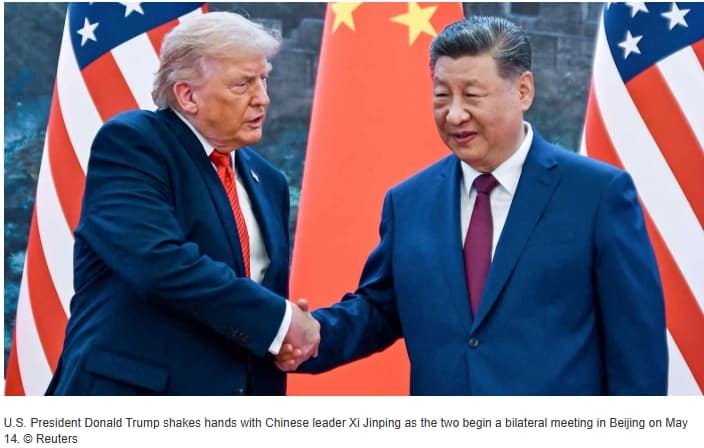
The summit, held at Beijing’s Great Hall of the People, focused heavily on trade, technology, Taiwan, energy security and the escalating crisis in the Middle East. While both leaders projected warmth and mutual respect in public, analysts say the meeting underscored the fragile and highly strategic nature of modern US-China relations.
Trump described Xi as “a friend” and told reporters the two nations would have a “fantastic future together,” while Xi called for 2026 to become “a historic and defining year” for bilateral relations. The meeting lasted more than two hours and was followed by discussions involving senior American business executives and Chinese economic officials.
At the centre of discussions was trade. Washington is pushing for expanded Chinese purchases of American goods, including Boeing aircraft, agricultural exports and energy supplies. Beijing, meanwhile, wants the United States to ease restrictions on advanced semiconductor technology and chipmaking equipment. China also renewed export licences for hundreds of US beef processing plants during the visit, a move interpreted as a goodwill gesture ahead of broader negotiations.
The White House confirmed that both countries discussed expanding market access for American businesses and increasing Chinese investment into US industries. Officials are also considering the creation of a joint “Board of Trade” mechanism aimed at managing commercial disputes before they escalate into tariff wars.
Diplomatically, the visit represented an attempt to stabilise relations after years of tariff battles, sanctions and military tensions in the Indo-Pacific. China used the summit to press Washington on Taiwan, which Beijing considers a core sovereignty issue. Xi reportedly warned that mishandling Taiwan could lead to “clashes and even conflicts” between the two powers.
Trump’s administration, however, appears to be balancing confrontation with pragmatism. Analysts say the White House increasingly recognises that prolonged economic conflict with China risks damaging global markets and American businesses already affected by inflation and disrupted supply chains.
The talks also carried major geopolitical implications because of the ongoing Iran crisis and instability in the Strait of Hormuz — one of the world’s most important oil shipping routes. According to White House officials, Trump and Xi agreed that the strait must remain open and that Iran should not obtain nuclear weapons. China, which maintains close economic ties with Tehran, is viewed as a potentially influential player in preventing further escalation in the Middle East.
Global financial markets reacted positively to the summit. Investors interpreted the meeting as a sign that Washington and Beijing are seeking managed competition rather than outright economic confrontation. European and Asian markets rose amid hopes that further tariff escalation could be avoided.
The International Monetary Fund also welcomed the renewed dialogue. IMF spokesperson Julie Kozack said reduced tensions between the United States and China would benefit the global economy at a time of slowing growth and heightened energy insecurity.
Despite the optimism, experts caution that the summit may produce limited structural change. Deep disagreements remain over tariffs, technology access, military influence in Asia and industrial subsidies. Think tanks including the Center for Strategic and International Studies and Chatham House argue that the meeting was less about resolving rivalry and more about managing it responsibly.
For Trump, the visit offered an opportunity to present himself as a global dealmaker capable of reopening dialogue with America’s biggest strategic competitor. For Xi, it reinforced China’s desire to project stability and global influence during a period of economic pressure and international uncertainty.
Whether the summit leads to lasting cooperation or simply delays another round of confrontation may become one of the defining questions in global politics over the coming year.

