




For millions of households across the United Kingdom, utility bills have become one of the biggest financial burdens of daily life. From gas and electricity to water and broadband, the cost of keeping homes running continues to outpace the comfort many families once took for granted.
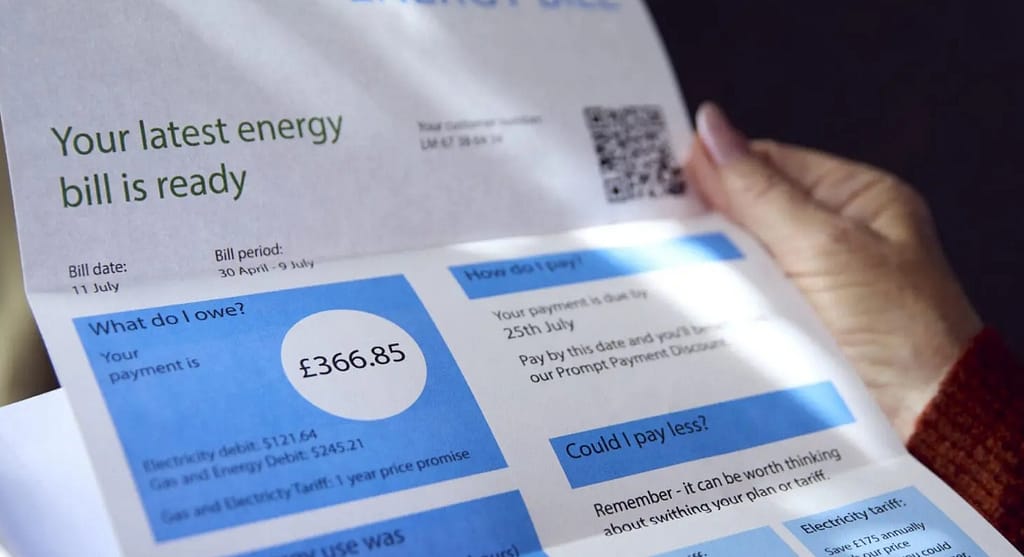
According to Ofgem, the UK energy price cap for a typical household rose to £1,849 annually between April and June 2025 before easing slightly to £1,720 for July to September 2025. Even with the reduction, bills remain significantly higher than before the energy crisis triggered by Russia’s invasion of Ukraine and wider global supply shocks.
For average British families already battling rising food prices, mortgage pressures and stagnant wages, the impact has been severe. Analysts estimate that a medium-sized UK household now spends roughly £4,400 annually on utilities and essential household services, including energy, water, council tax and broadband.
Consumer groups say the crisis is changing behaviour across the country. Families are reducing heating, limiting appliance use and cutting back on other essentials to keep up with bills. Community food banks and local councils have also reported increased demand for emergency support.
Jonathan Brearley, Chief Executive of Ofgem, recently warned that lower-income households could suffer disproportionately from the transition to cleaner energy systems if reforms are not introduced. He highlighted how fixed standing charges — costs added regardless of energy usage — have risen sharply in recent years.
The role of utility companies has come under increasing scrutiny. Major suppliers including British Gas, EDF Energy, Octopus Energy and Scottish Power argue that wholesale market volatility, infrastructure investment and environmental obligations have pushed operational costs higher.
Critics, however, accuse energy firms of protecting profits while consumers struggle. Public frustration intensified after several suppliers reported strong earnings despite widespread hardship among households. Online forums and social media discussions reveal growing anger over what many consumers see as a flawed pricing system.
Brexit has also played a role in the pressure facing UK utilities and consumers. Since leaving the European Union, Britain has faced new trade frictions, labour shortages and regulatory changes affecting supply chains and infrastructure costs. Analysts say the UK’s reduced energy interconnection flexibility with European markets has limited some opportunities for cheaper imports during periods of high demand.
Economists further argue that Brexit weakened the pound in the years following the referendum, making imported energy and raw materials more expensive. Combined with Britain’s heavy dependence on gas for heating and electricity generation, households have remained vulnerable to global price shocks.
The crisis has sparked growing debate within government and industry about long-term solutions. Experts are calling for major investment in renewable energy, insulation programmes and modernised electricity grids to reduce Britain’s reliance on volatile international gas markets.
Campaigners are also urging ministers to introduce a “social tariff” — a discounted energy rate for vulnerable and low-income households. Think tanks including the Resolution Foundation have argued that targeted support could prevent millions from falling into debt.
Meanwhile, energy efficiency remains one of the most immediate solutions available to households. Better insulation, smart meters and fixed-rate tariffs are increasingly promoted as ways to reduce consumption and protect families from future price swings.
Yet many experts warn that unless Britain fundamentally reforms its energy market and accelerates investment in domestic clean energy production, the pressure on ordinary households may continue for years.
As winter approaches once again, the utility debate is no longer simply about economics. For many families across the UK, it has become a question of financial survival, social fairness and the future direction of the country itself.

