




An “unprecedented” outbreak of Meningitis B has sent shockwaves through communities in Kent, leaving two young people dead and dozens more under urgent medical watch—while students at the centre of the الأزمة describe a frightening and fast-moving situation.

The outbreak, linked to University of Kent and several local schools, is believed to have originated from a “super-spreader” social event, with health officials pointing to heavy mixing at venues including Club Chemistry nightclub in Canterbury.
For many students, what began as a normal weekend quickly turned into panic.
“It all happened so fast,” one student said. “People started hearing that someone was seriously ill, then suddenly more cases were popping up. It was terrifying because no one knew who might be next.”
At the heart of the response is UK Health Secretary Wes Streeting, who has defended the actions of the UK Health Security Agency (UKHSA) amid criticism that the public was not warned quickly enough.
“This is an unprecedented outbreak. It is also a rapidly developing situation,” Streeting said, insisting that officials acted “as quickly and as comprehensively as possible.”
He emphasised that even before a formal public alert was issued, those identified as close contacts were already being offered antibiotics “as a matter of urgency.”
Health experts say the speed of the spread is unlike anything they have seen in decades.
“It’s the explosive nature that is unprecedented here,” said Susan Hopkins, chief executive of UKHSA. “In 35 years, this is the highest number of cases I’ve seen in one weekend with this type of infection.”
Dr Thomas Waite, England’s deputy chief medical officer, echoed that concern: “This is by far the quickest-growing outbreak I’ve ever seen in my career.”
The outbreak has now reached at least five schools, with one case reported in London after a patient travelled from Kent—raising fears among parents and communities beyond the immediate area.
Families of victims are still coming to terms with the tragedy. Among those who died was Juliette, an 18-year-old school pupil described by friends as “full of life,” and a 21-year-old university student whose sudden illness shocked classmates.
“It doesn’t feel real,” another student said quietly. “One minute you’re planning your week, the next you’re hearing someone you know is gone.”
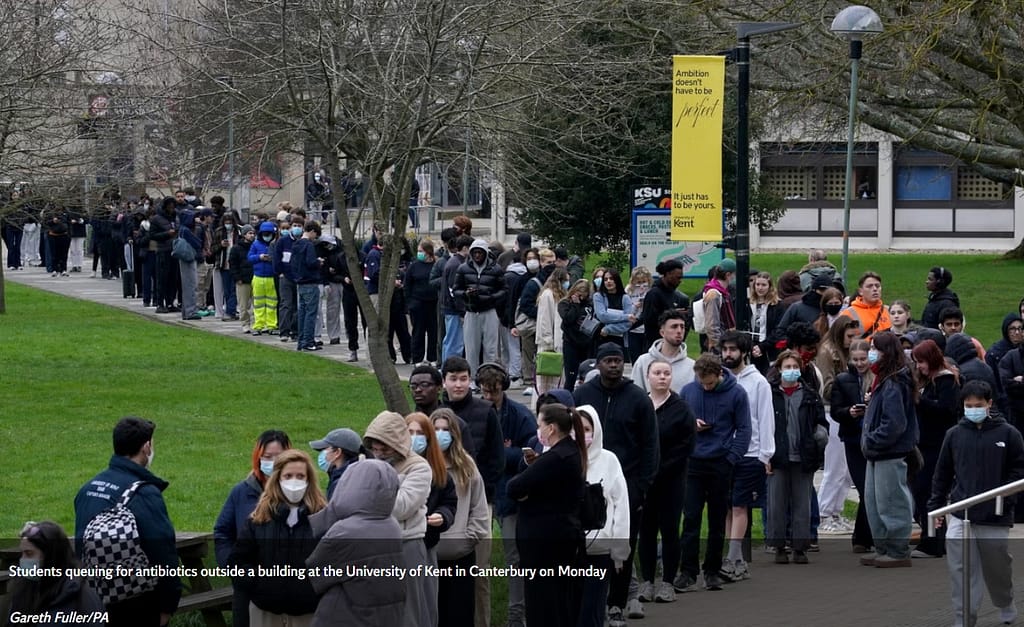
In response, health authorities have launched an emergency vaccination and antibiotic programme. Hundreds of students queued for treatment outside university buildings, while pharmacies struggled to keep up with demand.
However, officials have warned against panic buying. Streeting called it “immoral” for companies to exploit the الأزمة by charging excessive prices for private vaccines.
Experts are urging calm, noting that while the outbreak is serious, it is unlikely to spread nationwide.
“As long as people get antibiotics, it will stop the infection spreading,” said Professor Adam Finn. “There’s a bit of panic, but this isn’t something that will sweep across the country.”
Still, uncertainty remains—particularly around the specific strain involved and whether mutations could be driving its severity.
For now, the focus is on vigilance. Students have been advised to watch for symptoms such as fever, severe headaches, sensitivity to light, and neck stiffness.
Back in Canterbury, the mood remains tense.
“You just feel on edge,” a student admitted. “Everyone’s checking on each other, everyone’s being careful. We’re just hoping it stops as quickly as it started.”

