




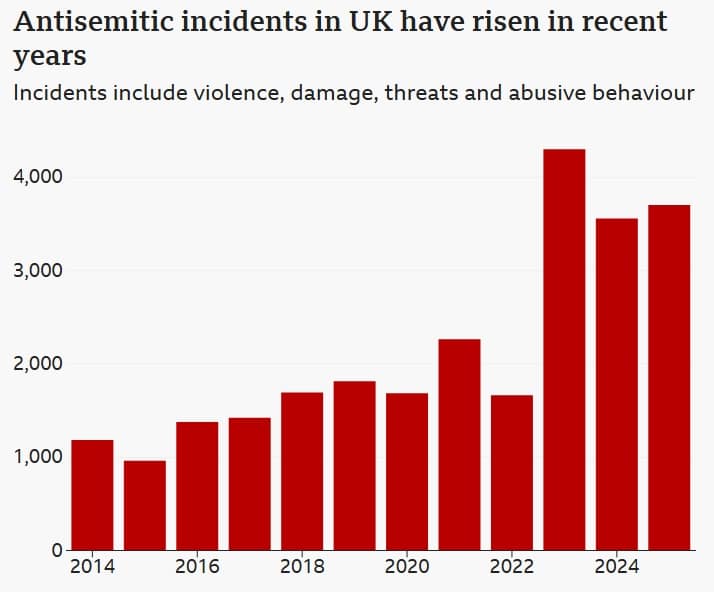
The recent attack targeting members of London’s Jewish community has understandably prompted fear, anger, and urgent calls for reassurance. For many British Jews, the incident is not isolated—it sits within a longer pattern of rising antisemitism that has made everyday life feel less secure. That reality deserves to be acknowledged clearly and without hesitation. When a community feels targeted for who they are, the response from government, media, and civil society must be swift, visible, and unequivocal.
Yet the public conversation that followed this attack has also revealed something more complicated—and more uncomfortable. In the rush to respond, a crucial detail appears to have received far less attention: among the victims was also a Muslim man. His experience, and the distress felt within the wider Muslim community, has not been given equal prominence in coverage or commentary. That imbalance has not gone unnoticed.
Moments like these test not only our capacity for empathy, but also our consistency.
The widely circulated footage of the arrest added another layer of unease. Seeing a Black man being forcibly subdued—particularly the moment in which he appeared to be kicked in the head—was deeply distressing for many viewers. For Black Britons, such images can resonate beyond the specifics of a single case, tapping into longstanding concerns about disproportionate use of force and unequal treatment within the justice system. These reactions do not negate the seriousness of the attack itself; rather, they highlight how different communities experience the aftermath of such events through different historical and social lenses.
The response from the state has been notably decisive. The decision by Keir Starmer to convene a COBRA emergency meeting signaled that the government views antisemitic violence as a matter of national urgency. That is, in principle, a positive and necessary stance. Any targeted hate crime should command that level of seriousness.
However, the contrast being drawn by some observers is not entirely unfounded. There is a perception—fair or not—that when Black or Muslim communities face violence or sustained discrimination, the response can feel less immediate, less visible, or less forceful. Whether this perception reflects reality in every case is debatable, but its existence alone is significant. Trust in institutions depends not only on what is done, but on how consistently it is seen to be done.
This is where the role of the media becomes critical. Editorial choices—what is highlighted, what is omitted, whose voices are amplified—shape public understanding. When one victim’s identity becomes central to the narrative while another’s fades into the background, it risks creating a hierarchy of suffering. That is not only ethically problematic; it is socially corrosive. It feeds the belief that some communities are more “worthy” of attention and protection than others.
A more responsible approach would insist on completeness. Every victim matters. Every community affected deserves recognition. This is not about diminishing the fear within the Jewish community—it is about ensuring that empathy is not a finite resource.
So what should be done?
First, government responses to hate crimes must be guided by clear, consistent principles rather than perceived political sensitivities. If an incident warrants emergency coordination and national attention, that threshold should apply regardless of the identity of the victims. Transparency around how these decisions are made would go a long way in building public confidence.
Second, policing must continue to be scrutinized with fairness and rigor. Accountability does not weaken public safety; it strengthens it. Communities are more likely to cooperate with law enforcement when they believe they will be treated with dignity and proportionality.
Third, media organizations must reflect on their framing. Balanced reporting is not about false equivalence—it is about completeness, accuracy, and the avoidance of selective visibility. Including all victims in the narrative is not an optional extra; it is a basic journalistic responsibility.
Finally, there is a broader societal obligation. Solidarity cannot be conditional. It is not enough to stand with one community while overlooking another; doing so ultimately undermines both. The safety of Jewish Britons, Muslim Britons, Black Britons—and every other group—is interconnected. A society that protects one group selectively is not truly secure.
The London attack should serve as a moment of collective reckoning. Not only about antisemitism, which must be confronted with absolute seriousness, but also about how Britain responds to harm across its diverse population. Equal protection under the law is not just a legal principle; it is a moral one.
If there is a path forward, it lies in rejecting selective empathy and embracing a more consistent standard: that violence against any community is a threat to all, and that every victim’s story deserves to be seen, heard, and remembered.

