



Vietnam’s political landscape has entered a significant new phase following the elevation of Tô Lâm to the presidency, a move that places him in a rare dual position of authority within the country’s tightly structured political system. Already a dominant figure as a senior leader within the ruling Communist Party of Vietnam, his assumption of the presidency signals a consolidation of power not commonly seen in recent Vietnamese governance.
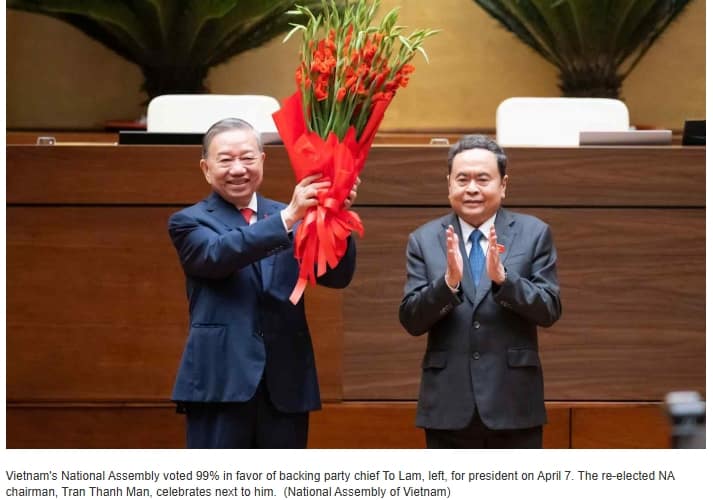
Tô Lâm’s rise reflects decades of influence built within Vietnam’s powerful security apparatus. Having spent much of his career in the Ministry of Public Security, he developed a reputation as a disciplined and strategic operator, deeply embedded in the state’s internal security framework. His leadership style has often been associated with stability, control, and a strong emphasis on institutional order—qualities that now shape his expanded role at the helm of the state.
The combination of party influence and state leadership positions places Tô Lâm in a uniquely powerful position, drawing comparisons to earlier eras in which authority was more centrally concentrated. While Vietnam maintains a collective leadership structure on paper, the alignment of these roles strengthens his capacity to influence both political direction and state policy.
Analysts suggest that this development comes at a time when Vietnam is navigating complex domestic and international challenges. From sustaining economic growth to managing foreign relations in an increasingly competitive geopolitical environment, the country requires coordinated leadership. Tô Lâm’s dual role may offer a more streamlined decision-making process, particularly in areas where political direction and state execution must align closely.
However, the consolidation of power also raises questions about institutional balance within Vietnam’s governance model. The country has, in recent years, emphasized collective leadership as a safeguard against excessive concentration of authority. By contrast, the merging of top roles under one figure could signal a shift toward a more centralized approach, even if formally within the party’s framework.
Supporters of the move argue that strong leadership is essential in maintaining political stability and continuity. Vietnam’s steady economic progress and its growing role in regional and global markets have been underpinned by consistent governance, and Tô Lâm’s experience may reinforce that trajectory. His background in security is also seen as an asset in managing internal cohesion and responding to emerging risks.
Critics, however, may view the development with caution, noting that concentration of power can limit internal debate and reduce the diversity of perspectives within leadership circles. The balance between efficiency and inclusivity remains a key consideration as Vietnam continues to evolve politically.
Internationally, Tô Lâm’s presidency will be closely watched. Vietnam’s strategic positioning—particularly in Southeast Asia—makes its leadership decisions significant beyond its borders. His tenure is expected to influence how the country navigates relationships with major global powers, regional partnerships, and economic alliances.
Ultimately, Tô Lâm’s assumption of the presidency marks more than a routine leadership transition. It represents a moment of recalibration within Vietnam’s political system—one that underscores the enduring importance of leadership structure in shaping national direction.
As Vietnam moves forward, the impact of this dual role will be measured not only by political stability, but by how effectively it balances authority with the principles of collective governance that have long defined its system.

