



Japanese automotive giant is set to begin importing Taiwan-manufactured Noah and Voxy minivans into Japan from October, marking a notable shift in the company’s production and supply chain strategy amid growing global competition and changing manufacturing dynamics across Asia.
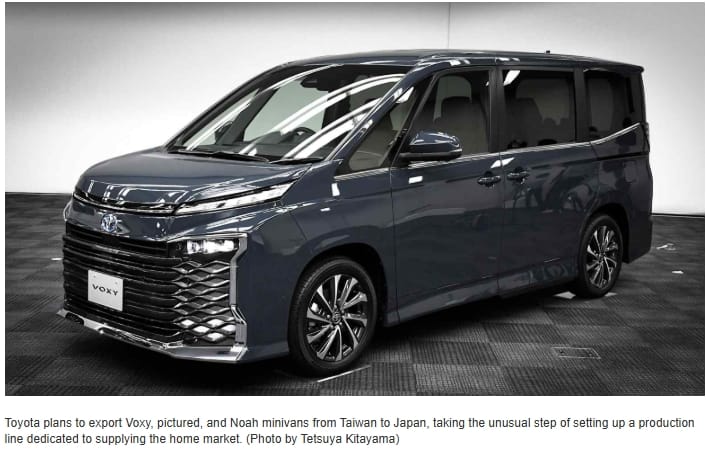
According to reports emerging from Nagoya, Toyota will commence operations on a dedicated production line in Taiwan during October, with the vehicles destined specifically for the Japanese domestic market. The move represents one of the rare occasions where vehicles produced in Taiwan will be sold directly in Japan at scale by a major Japanese automaker.
Industry analysts say the decision reflects Toyota’s broader efforts to optimise regional manufacturing efficiency, reduce production costs, and strengthen supply chain flexibility in an increasingly competitive global automotive landscape.
The Noah and Voxy minivans remain among Toyota’s most popular family-oriented vehicles in Japan, widely recognised for their practicality, fuel efficiency, and spacious interiors. Demand for compact multi-purpose vehicles continues to remain strong among Japanese consumers, particularly families and ageing populations seeking reliable and accessible transportation.
Automotive experts believe the Taiwan production initiative could allow Toyota to better balance domestic factory capacity while leveraging Taiwan’s growing manufacturing capabilities and strategic geographic location within Asia.
“This move demonstrates how modern automotive manufacturing is becoming increasingly regional rather than purely domestic,” one industry observer noted. “Companies are now prioritising efficiency, resilience, and cost competitiveness across integrated Asian supply networks.”
The development also signals Taiwan’s rising role in advanced manufacturing beyond its already dominant semiconductor industry. Taiwan has steadily expanded its industrial capabilities in precision engineering and automotive component production, making it an increasingly attractive production base for multinational corporations.
For Toyota, the decision comes at a time when global automakers are under mounting pressure to streamline operations while investing heavily in electric vehicle technologies, digital systems, and next-generation mobility solutions.
While the imported minivans are expected to maintain Toyota’s strict Japanese quality standards, the move may also test consumer perceptions regarding overseas-manufactured vehicles entering Japan’s traditionally domestically focused automobile market.
Nevertheless, analysts suggest Japanese consumers are becoming more accepting of globally produced vehicles as supply chains internationalise and manufacturers pursue greater operational efficiency.
The decision may ultimately serve as a model for future regional production strategies among Asian automakers navigating rising labour costs, supply chain disruptions, and intensifying international competition.
As the global automotive industry undergoes rapid transformation, Toyota’s Taiwan initiative highlights how even the world’s largest car manufacturers are rethinking traditional manufacturing boundaries in pursuit of long-term sustainability and growth.

