




A group of American solar manufacturers has petitioned the United States government to investigate allegations that Chinese companies are using Ethiopia as a route to bypass US trade tariffs on solar products, intensifying tensions in the global clean energy supply chain.
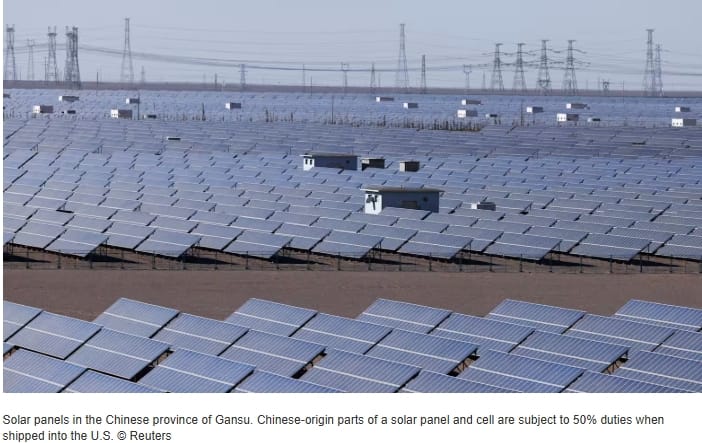
Eight US-based solar firms have formally requested that Washington examine a sharp rise in solar equipment imports from Ethiopia, arguing that some shipments may involve Chinese-linked manufacturing operations attempting to avoid existing trade restrictions imposed on Chinese solar goods.
The complaint reflects growing concern within the American renewable energy industry over what manufacturers describe as “transshipment strategies,” where production or assembly is shifted to third countries to circumvent tariffs and trade penalties.
The petitioners claim that imports from Ethiopia have increased significantly in a relatively short period, despite the country having only a limited historical presence in large-scale solar manufacturing. They argue that the trend warrants scrutiny to determine whether Chinese companies are relocating portions of their supply chains to African countries in order to maintain access to the US market.
The US government has already imposed tariffs and anti-dumping measures on several Chinese solar manufacturers in recent years, citing unfair state subsidies and below-market pricing practices. Washington has also expanded investigations into Chinese-linked manufacturing activities in Southeast Asia, where similar concerns over tariff avoidance previously emerged.
Industry analysts say Africa is increasingly becoming part of the global competition surrounding clean energy manufacturing and supply chain diversification. Countries such as Ethiopia are attracting growing foreign investment because of lower labour costs, improving industrial infrastructure and favourable trade access to Western markets.
Chinese companies have expanded their industrial footprint across Africa over the past decade, investing heavily in manufacturing, logistics, mining and infrastructure through partnerships tied to Beijing’s broader Belt and Road Initiative. Ethiopia, in particular, has positioned itself as an emerging manufacturing hub with industrial parks aimed at attracting foreign producers.
Supporters of Chinese investment argue that such projects create jobs, transfer technology and support industrialisation in developing economies. However, critics in the United States and Europe increasingly worry that global manufacturing networks are being restructured specifically to avoid trade restrictions while maintaining Chinese control over production systems.
The dispute comes at a sensitive time for the global solar industry. Governments around the world are pushing for rapid expansion of renewable energy infrastructure to meet climate targets, while simultaneously attempting to secure domestic manufacturing capacity and reduce dependence on foreign suppliers.
American solar manufacturers say unchecked tariff circumvention could undermine efforts to build a competitive domestic clean energy industry. They argue that lower-cost imports linked to subsidised Chinese production continue to place significant pressure on US manufacturers already struggling with price competition.
Meanwhile, renewable energy developers warn that additional trade restrictions could raise solar installation costs and slow the transition to clean energy by increasing prices for panels and components.
Ethiopian officials have not publicly responded in detail to the allegations, though trade experts note that any formal US investigation could place the country under increased international scrutiny at a time when it is seeking to expand export-driven industrial growth.
Trade analysts believe the case highlights the increasingly complex intersection between climate policy, industrial competition and geopolitics. As countries race to dominate the global green economy, disputes over supply chains, tariffs and manufacturing origin are becoming central battlegrounds in international trade relations.

