




The West Midlands is set to become a national leader in health and medical technology as Mayor Richard Parker pledged to turbocharge the sector — a move aimed at saving lives, creating thousands of skilled jobs, and igniting the region’s economic growth.
The announcement came during the Mayor’s visit to Coventry-based Cytecom, a pioneering diagnostics company that has developed a world-first technology capable of identifying the most effective antibiotic for a patient’s infection in under an hour — a major step forward in the global fight against antimicrobial resistance (AMR).
The breakthrough could save hundreds of thousands of lives and address what the World Health Organization has described as one of the top ten global health threats.
Cytecom’s rapid diagnostic system offers a vital tool in tackling AMR, which occurs when bacteria evolve to resist antibiotic treatments. This growing threat already accounts for 20% of global deaths through bloodstream infections and sepsis — figures expected to rise sharply without urgent intervention.
Traditionally, lab tests can take days to determine the correct antibiotic. Cytecom’s technology cuts that to under an hour, giving clinicians the ability to start the right treatment almost immediately.
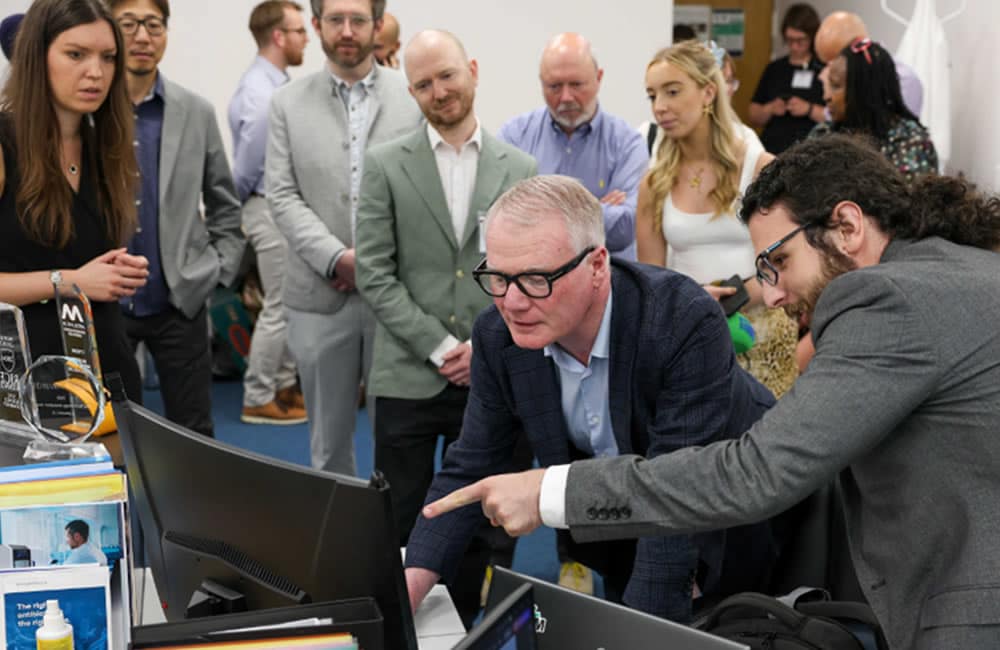
“Our technology gives doctors results in minutes instead of days, helping them choose the right antibiotic straight away — with the potential to save millions of lives,” said Dr. Magdalena Karlikowska, Cytecom’s CEO.
“Antimicrobial resistance already means longer hospital stays, higher healthcare costs, and tragically, more lives lost. We urgently need rapid tests like this alongside better antibiotic stewardship.”
The economic stakes are equally high. In Europe alone, AMR costs €11.7 billion each year in healthcare expenses and lost productivity. Without action, superbugs could claim 10 million lives annually by 2050.
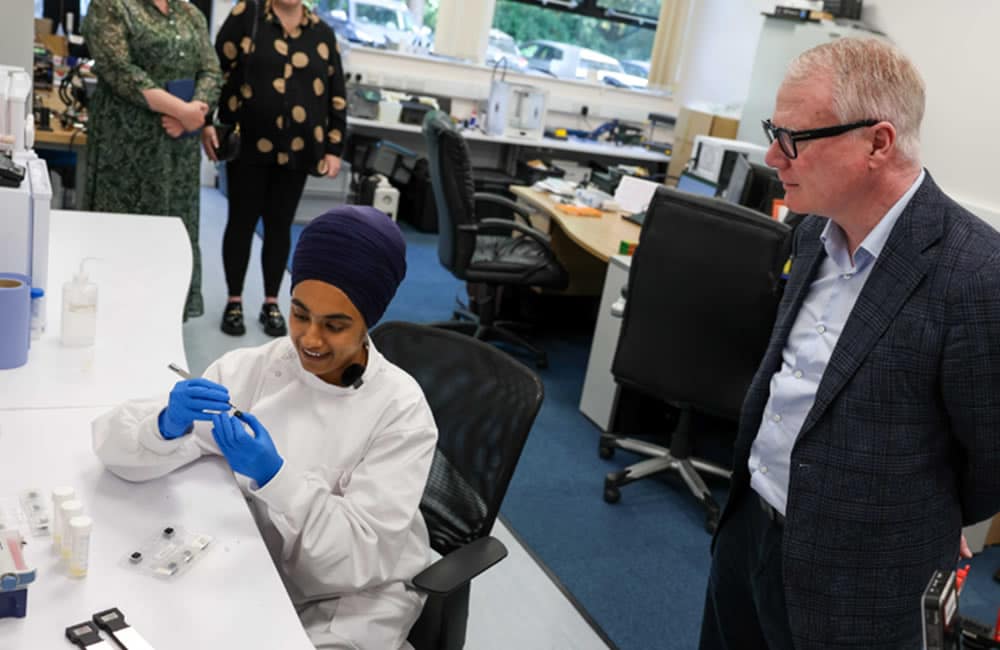
R&D scientist Inderpreet Kaur gives Mayor Richard Parker a demonstration of the diagnostic device – the first of its kind in the world
The Mayor’s visit to Cytecom underscored his broader vision to make the West Midlands the UK’s most attractive location for starting and growing health and medtech businesses.
The sector is already one of the largest and most respected in the UK, with around 700 firms employing over 14,000 people and generating £6 billion annually through the development of cutting-edge medical devices, diagnostics, and digital healthcare solutions.
Under the Mayor’s Growth Plan, the sector is earmarked as one of five high-growth industries — alongside advanced manufacturing, digital & AI technology, and business & financial services — capable of delivering 100,000 new skilled, well-paid jobs.
“Advances in technology, many of them developed right here in the West Midlands, are helping our doctors and nurses save more lives than ever before,” Mayor Parker said.
“But this isn’t just about health — it’s about building a futureproof economy driven by innovation, productivity, and secure jobs people can build their lives around.”
Cytecom is one of 114 health and medtech businesses supported by the West Midlands Health Technology Innovation Accelerator (WMHTIA) — a partnership of 21 academic, NHS, and industry organisations. The project has already attracted £50 million in private co-investment, accelerating the journey of companies from research to market.
Cytecom is also collaborating with Leicester University and NHS Leicester, backed by funding from the Department of Health and Social Care through the National Institute for Health and Care Research.
Inderpreet Kaur, an R&D scientist at Cytecom, demonstrated the device to the Mayor, while Tudor Onose, a 24-year-old iCASE PhD student from the University of Warwick, shared how his research is bridging academia and real-world impact.
“Working on this project alongside Cytecom has allowed me to bridge the gap between my academic background and tangible product development,” Onose said.
“It’s extremely rewarding to see my work directly helping doctors detect infections faster and improve patient care.”
The Growth Plan will see the West Midlands Combined Authority (WMCA) work closely with the Office for Life Sciences, local universities, and private sector partners to boost inward investment, strengthen business support, and use the region’s new Investment Zone sites as launchpads for medtech innovation.
Mayor Parker emphasised that the region’s combination of talent, infrastructure, and innovation-friendly policy makes it uniquely positioned to lead the UK in health technology.
“We have the skills, the ambition, and the innovation pipeline to make the West Midlands the UK’s number one hub for medtech,” he said, “By scaling companies like Cytecom, we can save lives, create jobs, and put our region at the heart of a global growth industry.”

