



In one of the most controversial decisions in African football history, Senegal national football team have been sensationally stripped of their Africa Cup of Nations title—two months after lifting the trophy in scenes of national celebration.

What was once hailed as a triumphant moment for Senegal has now been overturned by the Confederation of African Football, following a successful appeal by Morocco national football team. The ruling has awarded Morocco a 3–0 victory, effectively rewriting the outcome of a chaotic final that had already been marred by controversy, tension, and dramatic protests.
At the centre of the storm lies a moment that has now defined the entire tournament. During stoppage time of the final in Rabat on January 18, Congolese referee Jean Jacques Ndala awarded Morocco a penalty following a VAR review, ruling that Senegal defender El Hadji Malick Diouf had fouled Morocco’s Brahim Diaz.
The decision sparked immediate outrage among Senegal’s players and coaching staff, who were already incensed after a late goal by Ismaila Sarr had been disallowed for what many described as minimal contact. Emotions boiled over, and in a stunning act of protest, head coach Pape Thiaw instructed his players to walk off the pitch.
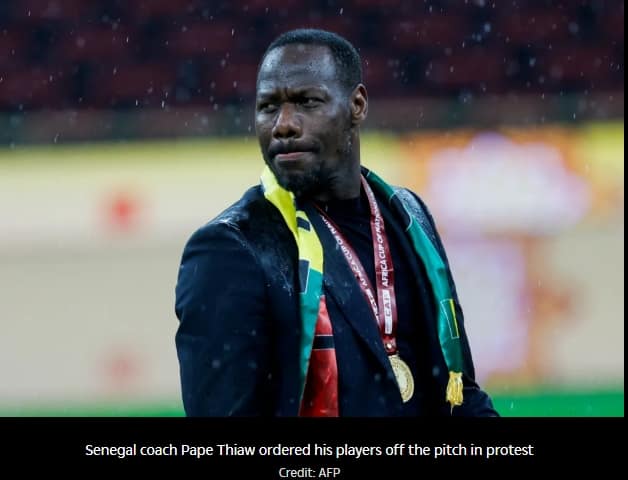
“It was a moment of disbelief,” one observer recalled. “The players simply refused to continue. You could feel the tension and anger spilling over—it was unlike anything seen in a final of this magnitude.”
As Morocco’s Diaz prepared to take the decisive penalty—one that could have changed the outcome—play was halted by Senegal’s protest. Ironically, when the penalty was eventually taken, Diaz failed to convert, attempting an audacious Panenka that missed its mark. Yet by then, the match had already descended into disorder.

Amid the confusion, Senegal legend Sadio Mane was seen urging his teammates to return to the pitch, appealing for calm and a resumption of play. Eventually, the game continued, and Senegal appeared to complete their fairytale victory when Pape Gueye scored in extra time to seal what was believed to be the winning goal.
Celebrations erupted across Senegal. Fans flooded the streets, players were hailed as heroes, and the trophy parade became a symbol of national pride. But behind the scenes, Morocco had already begun challenging the legitimacy of the result.
Their argument was simple yet powerful: the match, they claimed, should have been considered forfeited at the moment Senegal refused to continue playing. According to the laws of the game, a team that abandons play can be deemed to have forfeited the match.
After weeks of deliberation, CAF’s Appeal Board agreed.
In a statement that has since sent shockwaves across the football world, a CAF spokesperson confirmed: “The CAF Appeal Board decided that the Senegal National Team is declared to have forfeited the Final Match of the TotalEnergies CAF Africa Cup of Nations. The result of the match is now recorded as 3–0 in favour of Morocco.”
The governing body added: “The appeal lodged by the Moroccan Football Federation is declared admissible and is upheld. The original decision of the CAF Disciplinary Board is set aside.”
For Morocco, the ruling represents a dramatic and unprecedented reversal of fortune. While their players had initially left the pitch devastated, they are now, officially, champions of Africa.
In a measured response, the Moroccan federation emphasised that its actions were rooted in principle rather than rivalry.
“Our approach has never been intended to challenge the sporting performance of the teams,” the federation said. “It has been solely to request the application of the competition’s regulations. We remain committed to respecting the rules and maintaining stability within African competitions.”
Yet in Senegal, the reaction has been one of anger, disbelief, and defiance.
For many, the decision feels like a betrayal—not just of the team, but of the spirit of the game. The scenes of celebration that followed the final now stand in stark contrast to the administrative ruling that has erased them.
“This is more than football,” a fan said. “You cannot celebrate with a nation and then take it away months later. It doesn’t feel right.”
CAF’s decision has also revived criticism of the final itself, which had already drawn condemnation from global football authorities. Gianni Infantino, president of FIFA, had described the الأحداث as “unacceptable,” condemning the conduct of some Senegalese players and officials.
Disciplinary action followed swiftly. Coach Pape Thiaw was handed a five-match suspension for “unsportsmanlike conduct” and fined $100,000. Several players, including Ismaila Sarr and Iliman Ndiaye, were also sanctioned, alongside Morocco’s Achraf Hakimi and Ismael Saibari for their roles in the on-field clashes.
Despite the sanctions, the core issue remained unresolved—until now.
The ruling raises broader questions about governance, consistency, and fairness in African football. While the laws of the game clearly outline the consequences of abandoning play, critics argue that the emotional and situational context of the decision should also have been considered.
“Football is not played in a vacuum,” one analyst noted. “Yes, rules matter—but so does context. This was a final, under immense pressure, with highly contentious decisions. The human element cannot be ignored.”
Others, however, insist that CAF had little choice.
“If you allow teams to walk off without consequence, you undermine the integrity of the sport,” another expert argued. “This decision, as harsh as it may seem, reinforces discipline and respect for the rules.”
For the players, the emotional toll is undeniable. What was once the pinnacle of their careers has now been replaced by uncertainty and controversy. For veterans like Sadio Mane, who had once lifted the trophy in triumph, the reversal is particularly painful.
No official statement has yet been issued by the Senegalese federation regarding whether they will challenge the ruling further. However, reports suggest that efforts are underway to explore possible appeals at higher levels.
Meanwhile, Morocco’s players and fans are left to reconcile a victory awarded not on the pitch, but in the boardroom.
As African football grapples with the fallout, one thing is clear: this is a decision that will be debated for years to come.
It is a story of drama, नियम, and consequence—a reminder that in football, as in life, the final whistle does not always bring finality.

