



Britain’s political tensions over immigration and race took a disturbing turn this week after a newly elected Reform UK councillor in Sunderland was suspended following the resurfacing of racist social media posts targeting Nigerians living in the United Kingdom.
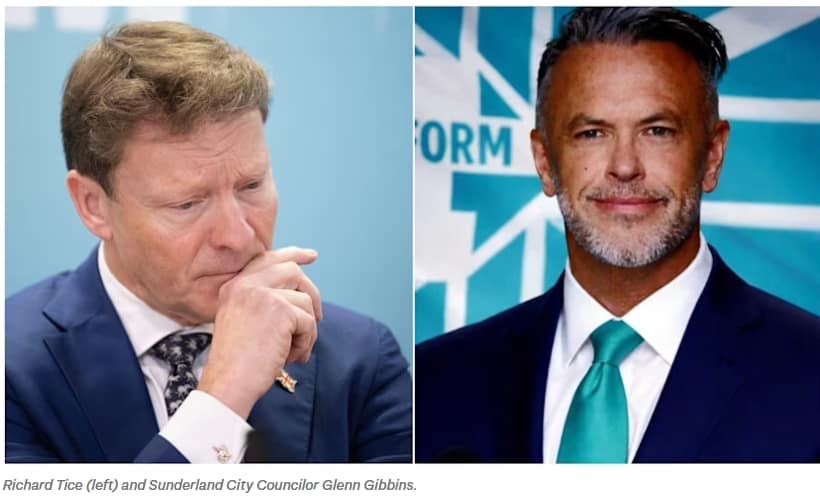
The councillor at the centre of the controversy is Glenn Gibbins, who was elected to Hylton Castle ward during the recent local elections that saw Reform UK make sweeping gains across northern England.
According to investigations by anti-racism campaign group Hope Not Hate, Gibbins posted comments in 2024 complaining about the “amount of Nigerians in town” before allegedly writing: “Should melt them all down and fill in the potholes.” The posts were later deleted but resurfaced shortly after his election victory.
The revelation has triggered widespread condemnation across Britain’s political spectrum and intensified concerns about racism within sections of modern British politics, particularly amid Reform UK’s rapid electoral rise.
The controversy erupted at a politically sensitive moment. Reform UK, led by Nigel Farage, achieved one of the most dramatic breakthroughs in recent British local election history, taking control of Sunderland City Council after Labour’s collapse in the city. Reform won 58 of Sunderland’s 75 council seats, reducing Labour to just five councillors after decades of dominance.
However, the success of Reform UK has now become overshadowed by questions over candidate vetting, political rhetoric, and extremist views within the party.
Following public backlash, Reform UK confirmed that Gibbins had been suspended pending an internal investigation. Yet the party’s response itself generated further controversy.
Richard Tice, Reform UK’s deputy leader, faced criticism after refusing during a BBC interview to directly condemn Gibbins by name. Instead, Tice accused sections of the media of attempting to “smear” Reform UK following its election victories.
Speaking on BBC’s Sunday With Laura Kuenssberg, Tice said:
“Like any party, we have internal party processes to look where people have said or done the wrong thing.”
He added:
“I condemn everything that is wrong and inappropriate.”
Critics argued that the response failed to directly address the racist nature of the comments.
A spokesperson for the Labour Party described the remarks as “utterly grotesque,” accusing Reform UK of failing to properly confront racism within its ranks.
Meanwhile, Bridget Phillipson, Labour’s Education Secretary and MP for Sunderland South, said the incident reflected “the kind of racism and division” Reform UK was bringing into British politics.
The controversy has also alarmed minority communities across Britain, particularly Black and migrant communities who fear the increasingly hostile tone of political debate surrounding immigration and identity.
Community organisations and anti-racism campaigners warn that inflammatory rhetoric by elected officials risks legitimising discrimination and deepening social division at a time when Britain already faces significant political and economic tensions.
The issue is especially sensitive in Sunderland, a city historically associated with industrial working-class politics and one of the earliest strongholds of Brexit support in 2016. Reform UK strategically focused its campaign heavily on immigration, national identity, and dissatisfaction with mainstream politics, themes that resonated strongly with sections of voters frustrated by economic decline and distrust in Westminster.
Yet the Gibbins controversy now raises broader questions about whether political anger is increasingly crossing into openly racialised discourse.
Political analysts argue that Britain’s democratic system faces a growing challenge: balancing legitimate public debates on immigration and economic pressures without normalising hate speech or targeting minority communities.
For Reform UK, the incident threatens to damage efforts to present itself as a serious national alternative to Labour and the Conservatives. The party has repeatedly claimed it operates one of the strictest vetting systems in British politics. Critics now question how a candidate with such publicly offensive comments was selected to stand for office in the first place.
The controversy also highlights the increasingly polarised state of British politics following the May 2026 local elections. As traditional party loyalties weaken and populist movements continue to grow, Britain appears to be entering a more fragmented and volatile political era.
For many Nigerians and Black Britons watching developments unfold, the remarks have been viewed not simply as offensive political rhetoric, but as a painful reminder that racism remains a serious issue in parts of British public life.
As investigations continue, the incident is likely to remain a major test both for Reform UK’s credibility and for Britain’s wider commitment to tolerance, accountability, and responsible political leadership.

